
Since I have no record of how I got Unequal Coverage, which I read on my Kindle e-reader, I thought I might have gotten it from Edelweiss Plus. It's on the Edelweiss website, so it's likely to be the source.
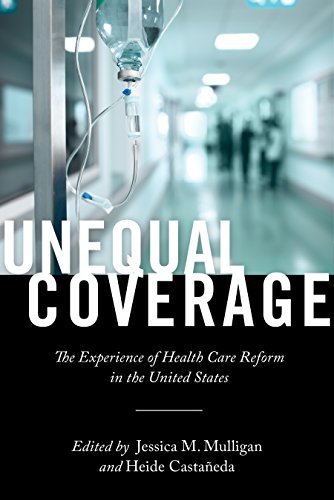
Unequal Coverage is a non-fiction book dealing with health insurance. I read it because I am alternating fiction with non-fiction, and I previously read a novel. I'm also very interested in health care reform, the topic of this book. The editors of this essay anthology are Jessica M. Mulligan and Heide Castaneda.
Apparently, the Affordable Care Act (ACA) didn't have as much positive impact on health insurance coverage as was intended. At the end of 2015, Blacks and Latinos had gains in coverage, but 21% of Latinos and 11% of Blacks were still uninsured. Undocumented and some legal immigrants were excluded from coverage. It's also pointed out that 1.4 million more Blacks would have been covered if states hadn't had the option to choose not to expand Medicaid.
There is a long history of opposition to programs that are perceived as benefiting people of color. Such opposition has mostly been concentrated in the South. As of 2016 90% of the people without health insurance lived in the South.
It was considered unfair that under the ACA contraceptive coverage only applied to women, and that men had to contribute to maternity care. It seems to me that only single men get no benefit from paying for maternity care under the ACA. Married men with families would get benefit from the ACA's maternity coverage because of shared family costs.
Most legal immigrants to the U.S. aren't eligible for health insurance during their first five years of residence. This is considered as creating stratified citizenship. Some citizens have more rights than others.
People who have been seriously injured are more likely to view health insurance as a necessity. I have no injuries, but regard health insurance as a routine cost, though it may become more expensive than it's been lately. As a senior, I don't consider being uninsured an option.
There is an essay in this book called "Texans Don't Want Health Insurance--Social Class and the ACA in a Red State" by Emily K. Brunson. Texas has the highest percentage of uninsured people in the U.S. The ACA improved health care access for some Texans, but there are also inequalities based on social class. The working poor didn't have options and continued to be uncovered. I'd imagine that this is because Texas chose not to expand Medicaid.
Brunson concludes that the ACA addressed some health care inequalities, but maintained others or even made them worse. It also created new inequalities.
There is a mention of a book called Dog Whistle Politics by Ian Haney Lopez that I would like to read. I put it on hold on my library website.
I had some comments on the essay "Stratification by Immigration Status" by Heide Castaneda.
I learned from this essay that some DACA recipients, who were children when they arrived in the U.S. illegally, could get health insurance through their employers. Yet I also learned that some legal immigrants can't get Medicaid for five years. If they earned less than the federal poverty level, they can get a subsidy to buy private insurance. This subsidy isn't available to U.S. citizens who earn less than the federal poverty level.
Later in the essay, there is a statement that documented immigrants are only partially included in the ACA. This explains the limitations in the above paragraph, but not why they exist.
There is discussion of the fact that non-citizens have no health coverage, and what happens in hospitals when non-citizens nevertheless need treatment, but can't afford it. Usually, they would end up using the emergency room for non-emergency treatment. One social worker reported that one undocumented immigrant had gone to the emergency room 28 times in the previous year. This increases government spending on healthcare. On the other hand, some documented immigrants feared that using any social services would cause them to be deported for becoming a "public charge".
There is an essay called "Stratification Through Medicaid" by Elise Andaya. Andaya maintains that Medicaid patients aren't treated with respect. They are unnecessarily made to wait longer times. Medical staff that the author contacted thought that Medicaid patients should also receive a lower standard of care because they were getting it for free.
In the essay "Increasing Access, Increasing Responsibility: Activating the Newly Insured" by Mary Alice Scott and Richard Wright, the authors mentioned that some new patients confused Medicaid with Medicare and thought they couldn't get Medicaid until they were 65. I have to say that I am not newly insured, but up until I read this essay I thought that Medicaid was Medicare for poor people and that you couldn't get it until you were 65. There might be wider misperceptions about Medicaid than Scott and Wright imagine.
In the conclusion by the editors, I learned that only 6% of the U.S. population ever got their health coverage through the Affordable Care Act. The editors fear that without the ACA the number of uninsured will skyrocket.
I was also struck by a footnote which revealed that Medicare was responsible for the de-segregation of U.S. hospitals because segregated facilities couldn't be funded by Medicare.
I thought this book was very important, but I rated it A- due to there being some repetition throughout the anthology. Repetition may be some sort of academic requirement, but I still find it an annoyance.


No comments:
Post a Comment