This review was intended for Shomeret: Masked Reviewer, but it originally appeared on Book Babe.
The odd thing is that like author Jo Walton, I read Plato when I was
fifteen. My father had allowed me to read anything on his bookshelves.
So I read his leatherbound edition of Plato's writings. My reaction to
Plato's Republic was quite different from Walton's. Reading
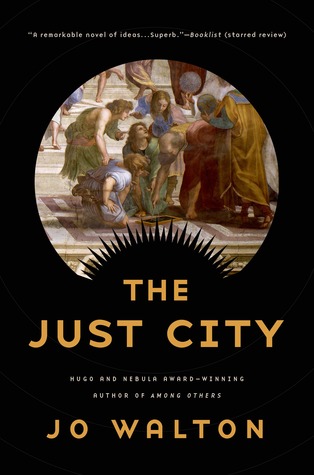
The Just City
caused me to remember. I was horrified by it. I didn't think that it
could possibly be a utopia. It was too regimented and undemocratic.
Yet Jo Walton says in the notes appended to the novel that she wanted to
re-create it at the age of fifteen and that this was the origin of
The Just City.
When
I discovered the existence of this novel , I had forgotten how I felt
about Plato's Republic when I was fifteen. I was curious about what Jo
Walton would do with her re-creation of Plato's idea of utopia. It did
seem like an original concept.
What
I liked most about the concept when I picked up the book is that the
city was established by the Goddess Athena. I thought that was
immensely cool ! What I disliked about it is that Plato's Republic was
being conflated with Atlantis which Plato wrote about in the Timaeus and
Critias dialogues.
Plato described Atlantis as
being a maritime power that was the rival of Athens which the Gods
destroyed. A civilization that rivaled Athens brings to mind the
legend of Theseus. The Minoans were so powerful that they could demand
the youths of Athens as tribute. Prince Theseus was sent as tribute to
King Minos. He was supposed to be sacrificed to the Minotaur at the
heart of the Minoan labyrinth. Many of us know how he survived the
Minotaur with the help of the Minoan Princess Ariadne.
Another
thing that is known about the Minoan civilization is that it was
destroyed by a massive eruption of the volcano on the island of
Santorini which was definitely occupied at the time. The Minoans wrote
in a script called Linear A which has no similarity to any known
language. It still hasn't been deciphered. This leads scholars to the
conclusion that the Minoans certainly weren't Greeks. Later the script
changed to Linear B which was discovered to be a form of Greek. The
islands that had once been ruled by the Minoans had been conquered by
the Greeks, but that was a post-eruption development. I am not the
only one who believes that Plato was describing the Minoan
Civilization. There are numerous scholars who have identified Santorini
as Atlantis.
So as I started reading
The Just City
there was this niggling voice in my head, asking what Athena had done
with the Minoans who would have inhabited the island where she had built
her re-creation of Plato's Republic. That voice never went away. I
kept wondering why those of the characters who had read the Timaeus and
the Critias dialogues weren't bringing up the original inhabitants of
the island. Socrates was a character in the novel. Wouldn't he have
been asking what happened to them?
I did see references
to Thessaly as the location in the novel. So it occurred to me that
the Goddess Athena had placed The Just City on an uninhabited island in
the Thessalian Sporades. Yet I couldn't find an island in the
Sporades with a volcano. Walton's fictional island did come equipped
with a volcano, and the plot required it to have one. So a Sporades
island didn't quite fit. Walton really needed Santorini, the Minoan
inhabited island whose shape changed radically around 1500 B.C.E. as a
result of one of the worst eruptions in history.
Why
couldn't I just relax and go along for the ride? Maybe it's because I'm
like the ever questioning Socrates. When I was a fifteen year old I
just loved Socrates. In fact, I wrote a play based on a few of Plato's
dialogues called
Socrates of Athens. Like the Minoan civilization, this piece of juvenilia no longer exists.
I
did go along for the ride to some extent. Walton created some
wonderful female characters who were part of this Goddess given
experiment. The Goddess herself wasn't one of them. I was delighted by
several human women who were brought to the island from various eras.
These were women who were non-conformists within their own historical
periods. They longed for the equality that Plato promised women in his
republic. For their sake, I wished that I could believe that Athena's
experiment would succeed. The Just City did initially seem like an
improvement to these women who came to instruct the children, and
identify the ones who could be potential philosophers.
Yet
as their pupils grew, the instructors encountered heartbreaking
dilemmas in their lives that were by no means utopian. The
responsibility for many of the problems could be laid at Plato's door.
They were inherent flaws in his concept of the republic that I noticed
when I was fifteen.
I didn't expect to find the God
Apollo sympathetic. His track record with regard to women in the myths
about him was abominable. Yet in this book, Apollo wants to
understand why one of those legendary women in Apollo's myths decided to
become a tree. He eventually learns the answer and it results in a
radical change in his outlook. I also really liked Apollo's unwavering
support for Socrates who uncovered a major fault line in Athena's
re-creation of Plato's Republic for which Plato couldn't be blamed.
As
I was approaching the end of the book, I thought to myself that I could
lay aside my obsession with historical detail because the book was so
well-written and dealt with the issues that arose in this attempt at
utopia in a complex and thought provoking manner. Unfortunately, the
abrupt ending annoyed me so much that I nearly canceled my plans to read
the sequel. And I still want to know where that grey eyed Goddess of
wisdom mislaid the Minoans.