Search This Blog

Monday, December 5, 2022

A Tempest of Death: A Terrifying Historical Novel

  Book Whisperer, a website for indie authors, asked me to review this book.  They contacted me on behalf of the author, Peter V. Wright.  My time for blogging is more limited these days.  I started A Tempest of Death on November 12 and finished it November 30. 


There were medieval and 20th century viewpoint characters in this novel.  I was grateful that the chapter headings with dates allowed me to keep track of when I was chronologically.

On the other hand, there was too much unnecessary history to wade through.  I might have finished this book sooner if there hadn't been so much historical information to record in my journal that I thought might be relevant for this review.

A Tempest of Death did occasionally educate me.  I have often seen "Albigensian",  but I never knew what it meant.  I decided to research it when I came across it in my notes.  I was surprised to learn from Wikipedia that Albigensians  are the inhabitants of the prefecture of Albi in Southern France, and that the artist Henri de Toulouse-Lautrec was born in Albi.  So the Albigensian Crusade described in this book took place in Albi.

Author Peter Wright's realism was admirable.  I can tell you that I was indeed immersed in the narrative, but sometimes felt overwhelmed.  This book is horrifying because it contains massive amounts of religious violence and genocide.  I have known about such real monstrous events.  So I have never needed to read about fictional monsters in order to experience horror. Real history is definitely horrifying enough.  I don't enjoy reading about those horrors, nor do I need reminders that they happened.  I have known holocaust survivors with numbers tattooed on their arms.  Readers who were born more recently and may have lived in protected environments, could experience genuine shock that humans do such things to members of their own species.  If you are such a reader, you have been warned by this review that A Tempest of Death contains this type of content.   


Sunday, November 13, 2022

Early Grave: The Final Novel of the Lassiter Series

My only read of November 2022 that I'm reviewing on this blog is the legal thriller Early Grave by Paul Levine which was sent to me by publicist Wiley Saichek.  This is the fourth book I've reviewed  from Levine's Lassiter series on this blog.  The previous three of these novels were Bum LuckBum Deal and Cheater's Game.  My reviews of those books can be found at their respective hyperlinks.  I decided that I could reveal that Early Grave is the last book in the Lassiter series because this information has already appeared in the description of Early Grave on Goodreads.  


 It's been two years since I last encountered Levine's protagonist, lawyer Jake Lassiter .   Lassiter's health, never very good because of the repeated concussions that he received when he was a professional football player, has declined even more in Early Grave.  Yet he has soldiered on.  At this phase of his career, he has been prosecuting  dishonest or incompetent lawyers.  

Lassiter went to a high school football game because his godson, Rod, was on the team.  Rod was seriously injured and ended up in the hospital.  Lassiter was bothered by the lack of a physician on the field when Rod was injured. 

 So he filed a lawsuit to temporarily enjoin high school football games until it  could be determined that they were safe.  The definition of enjoin that I am using in this context is "to prohibit by judicial order" which is a quote from Merriam-Webster.  

Regarding attitudes toward lawyers, Jake says "They don't call us sharks for our ability to swim."  I've never considered lawyers as a whole predatory.  I think that any profession contains predatory individuals, but there are also well-meaning lawyers who may even be idealistic.  After all, there are lawyers who do pro-bono work.  

If we didn't have lawyers, people would have to defend themselves in court with varying degrees of success.  People who don't have the ability to argue well would be at a disadvantage.  So would people who couldn't afford to pay legal expenses which are considerable. It seems to me that without lawyers our society would be even more unjust and lacking in equality than it is now.

The opposing lawyer in this case, mentioned that participation in high school football had been declining for the last ten years.  I found an article on the National Federation of State High School Associations website about the decline of participation in high school sports in general at NFHS.org.  I noted that they said they were working to make  high school football as safe as possible by "teaching proper tackling skills".   

The poet Langston Hughes and his poem "Let America Be America Again" was brought up in this novel. I wasn't familiar with this poem and did a search for it.  I found it here. Though the style isn't what I prefer in poetry, I thought it was thematically significant.  I recommend reading it. 

The resolution wasn't surprising to me, but I still found it moving.  I will give Early Grave four stars on Goodreads.


Friday, October 28, 2022

A Novel Dealing With The Iranian Jewish Community Circa WWII

A publicist asked me to read Love and War in the Jewish Quarter by Dora Levy Mossanen for review.  That was back in July.  I'm terribly sorry that it has taken so long for me to finish reading it. It's a World War II period novel, but being set in Iran makes it unusual.  I would like to thank publicist Emi Battaglia for sending me an advance copy of Mossanen's novel.  Love and War in the Jewish Quarter will appear on November 8.

One thing that drew me to this book is that Mossanen was born in Israel when it was in the process of becoming a state.  My grandmother was born in what would become Israel, though it was a good deal earlier than Mossanen.


Love and War in the Jewish Quarter opens in Tehran in 1941.  The main protagonist is a Jewish dentist who treats the Governor of Iran and his wife.  The dentist, Dr. Soleiman Yoran, had introduced novocaine to Iran.  He had brought his supply of novocaine from Paris where he went to dental school.

Soleiman's wife, Ruby, had died in childbirth.  Ruby had been a rebel.  I need to explain that during all Jewish synagogue services there were separate sections for men and women.  This is still the case among Orthodox Jews.  Among other Jewish sects, families are currently allowed to sit together for prayer. Mossanen reveals a scandalous incident when Ruby went into the men's section during the Sabbath service and sat down next to Soleiman.  This caused general consternation, but they stayed together smiling and holding hands.   I was smiling myself as I read this because I was brought up Orthodox, and could imagine how shocked everyone was.  Ruby continued to sit next to Soleiman at Sabbath services.  Over time increasingly fewer men attended.

We learn that Iranian Jews were required to have houses with low doors so they had to bow low as they left their homes.  Jews also weren't allowed to leave their homes on rainy days because they could supposedly drip Jewishness and defile Muslims.  So Iran was far from an ideal environment for Jews.

On the day when Soleiman was about to marry his second wife, he was summoned to the governor's bedside.  The governor had taken an opium overdose because he had been in terrible dental pain. Soleiman knew that he would be blamed for the governor's death.  He prevailed on a high official not to announce that the governor had died until the next day, so that Soleiman could get married.  

Velvet, the governor's wife, had inherited all his wealth.  She brought a sack of gold coins to Soleiman's wedding saying it was a wedding gift from the governor.   Soleiman said he couldn't accept it.  The father of the bride hauled the sack away saying it could be used by Tehran's Jewish community to build a hospital or other important projects.

I found Soleiman a sympathetic character and I admired him.  I also thought that Mossanen wrote very authentically about Jews.

The book ends with Soleiman's wedding to his second wife.  We don't find out what happens to Soleiman afterward. I would like to believe that he and his second wife successfully fled Iran, and eventually settled in Palestine.

From the acknowledgements I learned that Mossanen had felt for the first time that writing was lonely when she finished the manuscript of Love and War in the Jewish Quarter during a Covid quarantine. 

 I hope that Mossanen will write other books dealing with the less known aspects of Jewish history like this one.


Monday, September 12, 2022

Navajo Photographer Protagonist in a Mystery

 In order to make sure I would get a mystery read in September, I got one picked out even before I'd arrived at the halfway point. It was Shutter by Ramona Emerson.  The copy I'm reviewing is a library book.  The protagonist is a photographer which isn't all that unusual.  I've reviewed several books with photographer protagonists on this blog-- most recently Michael Angelo & the Stone Mistress by Steve Moretti.  Yet this is my first Navajo photographer protagonist. 


As the book opens, Navajo Rita Todacheene is a forensic photographer.  This means that she photographs crime scenes. Yet she also sees spirits which isn't a trait that would be considered compatible with professionalism in most work environments.  Needless to say, Rita must be careful not to reveal her paranormal gift  to officers in the Albuquerque PD. 

Being paranormally gifted, isn't the only way that Rita's job is problematic. I also knew that the Navajo avoid mentioning the dead or even the names of dead relatives.  So it seemed to me that Rita's job was extremely incompatible with her culture.  

The issue of the Navajo belief that the spirits of the dead (called "chindi" in mysteries by Tony Hillerman) could contaminate them, arose when Grandma took Rita to a church where ghosts were lingering.  I wondered why Navajo spirits of the dead would linger if they believed they were contaminating people that they loved.  Her grandfather's spirit worried that inimical spirits could make Rita crazy.

I was interested in the fact that Rita's neighbor was evidently a curandera.  Curandismo is a a Mexican healing tradition. She rubbed Rita with an egg, then she cracked the egg into a glass of water and told Rita to put the egg in the glass of water under her bed.  "Whoever has their eye on you will let you go," said the curandera.  There were also jars to put in each corner of the room.  Rita thought it was superstition.  I think that Rita's lack of belief in the measures that Rita's neighbor was taking to protect Rita would undermine their efficacy.

<Spoilers--

Rita learned Police Lieutenant Garcia was behind most of the local distribution of meth. This was a major revelation.  I wondered if Garcia did that because Latinos were being discriminated against when it came to advancement in the police department.  

End spoilers.>

It was mentioned in this book that Saint Veronica is the patron saint of photography.  Since I had never heard this before, I looked for a confirming link.  I found it at St. Veronica which links to a page about this saint's connection to photography.  Since Rita doesn't seem to be a devout Catholic, I didn't think that St. Veronica would have been significant for Rita.

There is a positive resolution to the book from a law enforcement perspective.  I decided to give the book a B+


Sunday, August 28, 2022

The Ambiguous Impact of Simone Weil

 I decided to read On The Abolition of All Political Parties by Simone Weil translated from French by Simon Leys because the title attracted my attention.  I also wanted to read a translated book by a woman during August which is Women in Translation month.


Simon Leys says in his translator's forward that "taking a conscience vote" in Parliament should be considered a pleonasm.  Pleonasm was an unfamiliar word to me.  I looked it up and discovers that it means redundancy.   

I wondered about Leys' perception.   Aren't members of Parliament supposed to be representing their districts, not themselves as individuals?  So therefore it's not true that they should always be voting according to their own beliefs.  They should be doing what their constituents want and need.  Representing their constituents is what's expected of members of Congress in the United States.  If  members of Congress don't do that, then the United States fails as a democracy. 

Leys, writing in 2012, says that although Weil wrote On The Abolition of All Political Parties 70 years ago, it's particularly relevant now.  Looking at politics in the United States in 2022, I think it's not just relevant but urgent.  I am an Independent who doesn't subscribe to political parties.   I realize that I am in the minority in my extremely partisan country.  

Weil writes that people join political parties in order to be politically effective even if the party doesn't represent their own beliefs and principles.  I don't understand why voters don't consider it counter-productive to achieve political success at the price of sacrificing their principles.  That isn't a victory for the voters.   It's a victory for the politicians who want to have power. 

Poet Czeslaw Milosz's essay "The Importance of Simone Weil" was included in this volume.  Milosz tells us that Simone Weil's support for labor unions caused her to go to work in factories for a year to experience what labor was like.  She contributed her pay to the labor unions.  Milosz says that Weil felt like a slave after having worked in the factories.  She died of malnutrition in a sanitorium.   I have questions.  Was her commitment to that institution voluntary or involuntary?  Did she die of malnutrition because she refused to eat or because the institution was starving her?   The answers to these questions would determine how I see Simone Weil.  

Weil apparently considered the Roman Empire a totalitarian society.  Totalitarianism was impossible until the existence of surveillance technology.  The Romans weren't capable of being totalitarians in our modern sense.  

Milosz said that both he and Albert Camus were drawn to Weil because of her certainty.  Camus was an atheist who doubted atheism and Milosz was a Christian who doubted Christianity.   Simone Weil had said that there were Pagans who were "naturally Christian" and Christians who were "naturally Pagan".  It seems to me that religious beliefs aren't innate.  There is no such thing as a natural adherent to a religion.   You are persuaded to become a religious adherent by your exposure to the religion and its beliefs.  

If I had to try to sum up the influence of Simone Weil on our present times, I don't think that I could do it.  There are unanswered questions that make her life and legacy unclear to me.  So I am inconclusive about Simone Weil at this point.


Friday, August 26, 2022

The Clerk's Tale: A Medieval Mystery With Too Many Characters

 I purchased a used copy of The Clerk's Tale by Margaret Frazer from a library sale cart.  It's the 11th book in a mystery series.  There have been 17 books in this series.  I've read a number of them long ago before I was online which was late in the 20th century.  I don't recall having read this particular book.  I'm sure it didn't exist when I was reading earlier books in this series.

I've seen reviewers complain about an excessive number of characters making a novel too complex to follow.  This is the first time that I thought so.  Maybe I'm losing the ability to track all these characters that I once had.  All I know is that I had to page back more than once to where characters were introduced in order to identify them. I also wished that I had been reading this book on Kindle so that I could find past references to characters more easily.  It occurs to me that Kindle features have made me a lazy reader.  I don't have to remember a long list of characters and who they are, if I can find that information using Kindle searches.  It's a possibility.   

Now I need to get into other aspects of The Clerk's Tale, so I can consider this a proper blog review. 


                                 cover image THE CLERK'S TALE: A Dame Frevisse Medieval Mystery  


While I was reading this book, it seemed odd to me that characters mentioned that Nichola was rather young to be a wife at sixteen.  I've read that it was common during the medieval period to marry girls in their teens to men in their thirties or forties.  I've seen many references in  books to fourteen year old medieval wives. Yet in a search I did for this review, I found an essay here called "This Is What It Was Like To Be A Teenager in the Middle Ages" by Oxford history professor Rachel Moss that indicated that marrying adult men to teen girls wasn't a common practice during that period, and states that medieval people were aware that teenagers weren't fully mature.  So it seems that  The Clerk's Tale is more accurate than other medieval novels that I've read containing teen brides.

Lady Agnes asks protagonist Sister Frevisse to read aloud a Chaucer tale that I've never heard of called "The Tale of Sir Topas".  Apparently, Chaucer intended it to be humorous.  The characters who listened to Frevisse read it laughed.  So apparently Chaucer succeeded in conveying humor to them.  I'm not sure if I would have reacted similarly.  Chaucer might have been disappointed with my reaction. When I read the summary which said that it involved a search for the Elf Queen, I thought that I would have been more intrigued than amused.  But then, I'm a fantasy fan. 

Getting into the mystery aspect, which didn't interest me as much as the historical context, I wondered why the jury for one of the murders was formed from people who experienced an event associated with the murder.  Perhaps during the medieval period objectivity wasn't considered as important in the jury selection process as it is now. It seemed like trials were ad hoc affairs, and that having the trial take place ASAP was a much greater priority than it is now.  The trial took place before an investigation was called for which seems backwards to me. 

 I've read many medieval mysteries that didn't seem so alien as this one did.  I think that the mystery aspect wasn't as strong as the history content.  Yet there was also some good character development which increased my estimation of the book.


Sunday, July 31, 2022

We Organize to Change Everything: An Abortion Essay Anthology

 I received a copy of this anthology of abortion essays for review from the publisher.

Below are the significant comments about this book from my journal that I'm willing to put on the internet.  


In the first essay by Jenny Brown, she refers to Neoliberalism.  She means the British version of liberalism.  People who aren't aware that "liberal" once had another meaning might be confused. It's based on an older definition of liberalism that goes back to the 18th century, a philosophy that supports freedom, equality, human rights and democracy, as opposed to monarchy or other types of authoritarianism.  See the Wikipedia article on the subject here.  In the 19th century liberalism evolved into a political philosophy of free enterprise.  It still retains that meaning in the modern UK.  In the U.S., it essentially means the opposite.  It's a preference for government intervention in order to assist minorities and the impoverished.  This is another example of "two great nations separated by a single language".  Oscar Wilde originally said something similar in The Canterville Ghost.  

It entertains me to think that the Hyde Amendment is related to Robert Louis Stevenson's character Mr. Hyde who turned into a monster. This is a law that doesn't allow the U.S. federal government to fund anything involving abortion unless the abortion saves the life of the mother, or is the result of rape or incest.  I do find the practical results of the Hyde Amendment rather monstrous.  Non-consensual pregnancies aren't in the interest of mothers, children or families in general.

In the essay "Labor Crisis in the Clinics" two Planned Parenthood workers have a discussion with journalist Amy Littlefield.  I mention it in this review because I learned from this essay that some Planned Parenthood workers are unionized, and that the relationship of the union with those who run Planned Parenthood is very adversarial.  I will never think about Planned Parenthood the same way again.

One of the essayists in this anthology says she had been a supporter of abortion rights since she was ten years old. I hadn't even heard the word "abortion" at that age. I feel that there is a vast chasm that has opened up between the world of my childhood and the world that I live in now.  

I learned some things that I hadn't known, but more importantly this book caused me to think more about the topic of abortion than I had previously.  I'm glad I read this book.


Tuesday, July 5, 2022

Phasers on Stun

I purchased Phasers on Stun  from an independent bookstore after having seen it in the bookstore's window.  I am a Star Trek fan, and I thought this book might contribute to my knowledge of recent Star Trek  developments.  This is my first July read.

Readers may wish to know that I reviewed  Beaming Up and Getting Off , the most recent version of Walter Koenig's memoir , here. Walter Koenig played Ensign Chekov on ST: TOS (The Original Series)


Author Ryan Britt is a journalist.  In this book, he deals with all the extant versions of Star Trek in depth.  If any version of Star Trek changed your world, you might find what Britt has to say about it significant. 

I was delighted to see Britt's comments about spoilers.  He says that there have been studies which prove that spoilers don't ruin anything.  He points out that spoilers are taken out of context.  So the experience of learning about a spoiler is very different from viewing it in the context of the entire work.  I have often experienced this.  I like spoilers.  They help me to decide whether I'd like a book, a TV show or a movie.  I never feel that the experience of reading or viewing the material in its entirety has been ruined by the spoiler.  In fact, if I thought the spoiler was rather wonderful, I anticipate it and it increases my enjoyment of  the complete work.

 At times, I found Britt very patronizing .  He calls Star Trek "kitsch" and "goofy".  I resented his attitude.  He seemed to be completely unaware that he was offending fans.  Fans aren't just people who watch a series.  They love it, they identify with it and it becomes a significant part of their lives.  I imagine that Britt immersed himself in Star Trek for the purpose of writing the book, but he probably couldn't imagine the mindset of a Star Trek fan.  So it doesn't occur to him that he's alienating a good proportion of his readers with his patronizing comments.  He probably thinks that people who read his book secretly share his opinion of Star Trek.  I hate to break it to him, but no they don't if they are genuinely fans of the Star Trek universe.  There was a time in my life when Star Trek: TOS felt extremely meaningful to me.  It doesn't feel the same way to me now, but I don't disown those feelings.  TOS is a part of me.

 I was shocked to learn from Britt that TPTB (The Powers That Be-- in this case it means the show runners) consulted with a man who fraudulently claimed to be an American Indian to determine if Chakotay on Voyager was authentic.   The man who called himself  Jamake Highwater was actually Jack Marks, and he had no Native American ancestry.   If I were going to use someone as an expert in a certain area, I would vet them first. 

Britt thinks that the ratio of those who have seen the Star Trek movie, First Contact, compared to those who have seen the ST:TOS episode Metamorphosis must be a thousand to one.  Well,  I'm one in a thousand then.  I thought "Metamorphosis" was a beautiful and moving episode, and I absolutely despised  the portrayal of Zephrem Cochrane in First Contact.  Ugh!  It would be hard for me to find a worse translation of a character, who had been portrayed earlier, into film.

Toward the end of this book, there is a reference to fans wearing buttons saying "I like REAL Star Trek, forget that bald guy."  My equivalent button would be "I like REAL Star Trek, forget the White guys."  You see, in my favorite Star Trek a Black man is in command, Avery Brooks. 

I loved Deep Space Nine from the very first episode.  I thought the characters were awesome particularly Dax who is a Trill.  Trills are ancient beings whose personalities are inserted into different individuals over time. Jadzia Dax is a young woman and was the most recent Dax.  We see earlier hosts for the Dax symbiont in flashbacks.  I find this very fascinating.

It was enjoyable to re-live the earlier Star Treks that I've seen through Phasers on Stun and to learn about the newer series that I haven't seen. I'm considering viewing Discovery and Strange New Worlds.  There's just so much for me to catch up on in digital format.  


Monday, June 20, 2022

Disability Pride

Disability Pride by Ben Mattlin was a book that I downloaded from Edelweiss, which provides digital copies of books in advance of publication.  Mattlin's book is scheduled to be published in November 2022.  I feel privileged to have read it early.


  My review of Disability Pride appears below.


 I have written on disability topics previously on this blog.  Most of my focus in this area has been given to books dealing with deafness or deaf issues.  This was due to my co-blogger relationship with deaf author and fashionista, Tara Chevrestt. 

(Update on Tara: Tara is now primarily blogging about fashion at  Pin Up Gals , and I have re-shaped what was originally her blog called Book Babe as a blog dealing with books centering on strong female protagonists called Flying High Reviews.) 

 If you would like to see my posts about books dealing with disability see my review of Disabled People Destroy Science Fiction (which is a sarcastic title) here, my review of a novel about a mute woman protagonist here, my review of a novel taking place at a deaf boys' school in the UK here, my review of a novel about a 15th century non-disabled Jewish woman with a deaf father here, and my review of Inside Deaf Culture here.

The author of Disability Pride, Ben Mattlin, was born with spinal muscular atrophy.  He couldn't sit himself up as a baby, and he has never stood or walked.  It's a progressive disease which means his condition is worsening. Yet he is married, and they have two daughters in their twenties.

As a former New York resident I was interested to learn that there are only 124 subway stations that are accessible for disabled passengers.  There are a total of 472 subway stations.  In 2020 a federal judge ruled that the New York MTA must add elevators to every station that is renovated.   The MTA  hopes to make 70 more stations ADA accessible by 2024.

 The next issue that I need to discuss in the context of this review is support animals that are not allowed in the cabin during a plane trip.  This is supposed to be considered discrimination.   Airlines do allow animals that are small enough to sit on a passenger's lap or under the seat.  If they are too large to do either of those, I suspect it's probably a safety issue rather than discrimination. When food and drinks aren't being served, aisles must be kept clear in case of an emergency. I think that's common sense. 

This book mentions a 19th century individual with a disability who I think should be celebrated.  He is Thomas Wiggins, a blind man who toured performing music he himself had composed. Wiggins was invited to the White House to perform for President James Buchanan. I found a page on the Black Past website devoted to Thomas Wiggins here.

I also recently saw opera singer Andrea Bocelli perform on television and didn't realize that he was blind.  If I were a fan of Bocelli who followed his career, I probably would have. Although I enjoy opera, I admit that the performers whose careers I do follow are singers of either folk songs or popular music. 

I was shocked to learn from Disability Pride that in the 19th century it was illegal for disabled people to appear in public in San Francisco.  There were other cities where this was also a crime.  Chicago kept the law against disabled people on the streets longest.  It was enacted in 1881 and repealed in 1974.  Most disabled people were beggars which was considered a disturbance of the peace. People were actually arrested for the crime of being disabled and appearing in public!

Neurodiversity was coined in 1988 by an autistic Australian graduate student named Judy Singer.  It was derived from the term "biodiversity" .

According to the CDC, one in 59 Americans is autistic.  By the way, I had to figure out that Mattlin meant the CDC.  Sometimes this author's meaning needs to be deciphered.  He has a highly individual way of expressing himself.

I learned from this book that Greta Thunberg is autistic.  The author comments that idolizing famous autists like Thunberg is a distraction from normalizing neurodiversity.  Excuse me, I admire Thunberg for what she has done as a climate activist.  I imagine there are a great many people who don't know that she's an autist.  It seems to me that focus on Thunberg  probably doesn't impact the cause of normalizing neurodiversity one way or another.  But that's just me.

I would like to bring up a piece of litigation that was discussed in Disability Pride.  In 1995 two institutionalized women with disabilities sued the state of Georgia to receive treatment at home.  The primary plaintiff was Lois Curtis, an autistic Black woman.  Their doctors agreed that they would be able to live at home if they had the support to do so.  The state denied them, but it was appealed to the Supreme Court by Georgia's Commissioner of Human Resources, Thomas Olmstead.   The case was decided in favor of the plaintiffs.  Ruth Bader Ginsburg wrote the majority opinion which stated that people who needed treatment for mental illness that could be treated in a community setting, should be allowed to live in the community if that is their preference. Such individuals could not be institutionalized against their will.  I found a page from The Arc, an advocacy and education organization for disabled individuals, that honored Lois Curtis this past February in the context of Black History Month here .  I hope that Lois Curtis continues to be remembered as a pivotal figure in the struggle for the rights of disabled people.  

Although my notes on this book took up half a book journal volume, I've already included all the comments that were substantive.  I thought this was an interesting and insightful book, though as I've mentioned I sometimes had a hard time figuring out what Mattlin intended to say.


Wednesday, June 15, 2022

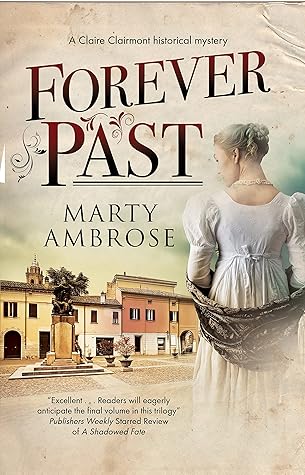
Forever Past: Volume 3 in a Claire Clairmont Mystery Trilogy

Like the first two volumes in this trilogy dealing with the life of Claire Clairmont, I was requested to review this one by the publicist who is now MaryGlenn M. Warnock. Warnock mailed me a hardcover copy which I began reading on June 10, setting aside the book I was reading at the time.                                         

 For background on Claire Clairmont see my reviews of the previous two books in the trilogy.  My review of Claire's Last Secret can be found here , and my review of A Shadowed Fate is here.  

When I wrote the original version of this review, there was no cover for  Forever Past and the page for the novel on Goodreads was incomplete.  There is now a cover for this book which I am adding below.  

                                    60912643. sy475


Claire in continuing to try to discover what happened to her daughter, Allegra, whose father was the poet Lord Byron.  Byron was his title.  His actual name was George Gordon.  (See the Wikipedia article on Lord Byron here.) He recognized Allegra as his daughter.  So it seems to me that her name would have been Allegra Gordon.

Setting the issue of what her name should be aside, Byron was trying to protect Allegra from assassination due to her being his daughter.  He himself was continually dealing with such threats.  Her life would be safe if no one knew where she was.    

Byron's involvement in a radical secret society would seem likely to have been the reason behind the assassination threats.  Certainly, keeping Allegra far from his political activities would have had a protective effect. 

The thriller aspect of this book eventually comes to a climax.  Some readers would have found those developments surprising.  I was briefly surprised, but current politics caused me to realize that I shouldn't have been astonished at all. 

There was a happy ending for Claire in this novel. There had not been a happy ending for her in real life.  I did think that the alternate events described in this book were possible. I like happy endings when they aren't completely beyond the realm of possibility.   So I thought Forever Past  was credible.  I gave it a B.


Monday, June 6, 2022

The Hidden One--A Contemporary Amish Mystery

 The Hidden One is the 14th book in the Kate Burkholder  mystery series by Linda Castillo. Kate Burkholder is a Chief of Police  with an Amish background.  She had left the Amish community some time ago, but still has connections there. I have never read any other book in this series, but I did review another novel focused on an Amish protagonist.  It was Her Fear, a romantic suspense novel by Shelley Shepard Gray.  See my review of Her Fear here if you are inclined to do so.  I received a copy of The Hidden One from the publisher via Net Galley.


We learn that Kate's significant other, John Tomasetti,works for the Ohio Bureau of Criminal Investigation.  I was curious so I decided to look it up on Wikipedia.  I discovered something about its history that sounded very inappropriate to me.  It was founded in 1921 as a record keeping facility, and convicts maintained the records.  This meant they could potentially change their own records or even make sure they disappeared.  Why didn't this occur to those in charge?  It really sounds bizarre to me.  I guess that this is another example of fact being stranger than fiction.

Kate has been asked to investigate the murder of an Amish bishop.  A member of the Amish community is being held by the police because his hunting gun was found at the crime scene.  His name is Jonas Bowman.   The elders don't believe that Jonas could have committed this crime.  Kate doesn't believe it either.  She and Jonas were close when they were teens.

The police had arrested Jonas because he had accused the victim, Ananias, of having caused his father's death by heart attack.  They argued very publicly.  Jonas actually threatened Ananias. Then Jonas damaged Ananias' buggy and Ananias called the police.  Two months later Ananias died.  Jonas admitted that the murder weapon was his though he hadn't seen it for years.  He said that he just lost track of it.  He certainly looked like a likely suspect. On the other hand, the gun was kept right near the door.  Anyone who knew that could have come in and taken it. 

One of the characters belongs to a sub-sect called the Byler Amish.  They have bright yellow topped buggies.  I found a photo of a yellow topped buggy on Wikipedia that was from Belleville, Pennsylvania where this novel takes place. So I decided to include it in this review below.


There are mentions of certain characters who have a "funny accent" when they speak the Amish language, Deitsch.  Such differences in speech play an important role in the plot of The Hidden One. 

According to a Wikipedia article on the Pennsylvania Dutch language, most Amish settlers originally came from a region of Germany called the Palatinate.  The Wikipedia article goes on to say that modern Germans who come from that region will be able to make themselves understood to the Amish in a limited way.  Yet, it may cause the Amish to think that they speak Deitsch strangely.

The Hidden One took longer for me to read and review than expected. I have been distracted lately.  I hope to be more focused on reading and reviewing going forward.


Thursday, June 2, 2022

How to Raise an Antiracist

I'm having problems finding time to read and finish books lately.  One of the problems is that my transit time is so brief .  In the past, I used to while away my time on buses and trains reading.  Now I reach my destination before I've even finished a chapter.  Another problem is being drawn into TV news at home.  There's so much going on that's really important, but I don't discuss current events in my reviews unless they're relevant to the book.  So let's get on to the review.  I received a copy of How To Raise An Antiracist by Ibram X. Kendi  from the publisher via Net Galley.


 I had never read a book by this critically acclaimed author though I did read an essay by him in The 1619 Project which I reviewed here .  Kendi intended this book for parents.  I need to tell readers that I'm not a parent, but I am interested in antiracism.  

Kendi points out that to do nothing about racism means that you are upholding it.  I haven't done nothing, but I can't say I've done very much.  The publisher sent this book to me because I reviewed  The Sum of Us by Heather McGhee  here back in February of 2021.  I've also taken an anti-racist perspective in a couple of reviews I've written since then.  Yet I am not an activist. I don't feel I can pat myself on the back for writing reviews. I should do more.

In some ways this was too personal a book for me to review.  My book journal notes contain many specific references to my upbringing in response to Kendi's discussion of raising childen. I don't feel it's appropriate to include such comments in a published review.

Kendi's mention of his high school, John Bowne High School in Queens, caused me to research 17th century Quaker, John Bowne. I drew on Wikipedia and a Quaker site  called  A History of Flushing Meeting

John Bowne was arrested by Peter Stuysvesant in 1662 for allowing Quaker meetings in his home. The Dutch Reformed Church was the established religion in what was then Dutch ruled New Amsterdam.  It didn't become New York until the English took over in 1664.

John Bowne appealed to the Dutch West India Company which was the ultimate authority in the colony. He asked them to overrule Stuyvesant and enforce the 1645 Flushing Charter of Religious Freedom. Quakers had complained in 1645 that they should have freedom of conscience.  This was called the Flushing Remonstrance which resulted in the Flushing Charter of Religious Freedom.  The Dutch West India Company responded that "the consciences of men at least ought ever to remain free and unshackled".  

The last few paragraphs represent a detour from the primary theme of How To Raise an Antiracist.  Readers need to realize that John Bowne owned slaves. He was not the only Quaker who did own slaves.  See my review of Slavery and the Meetinghouse, a book dealing with 19th century Quakers and slavery here.  Caring about your own religious freedom doesn't mean that you necessarily care about whether other human beings are enslaved.

So Kendi mentions that when his parents moved to Virginia, he ended up attending Stonewall Jackson High School. Kendi said that it was named as "a middle finger to the civil rights movement".  

At that point, I wanted to know when the civil rights movement really began.  I wasn't taught anything about the civil rights movement until the 7th grade, and then it was about beliefs and principles rather than events.   I found a Civil Rights Movement Timeline and was astonished to find that the first event listed was in 1948.  Harry Truman issued Executive Order 9981 to end segregation in the U.S. military. 

Kendi cites research that says that people who grow up in White neighborhoods and attend White schools, are apt to think that when things go missing, someone Black must have stolen them.  There was an incident of theft in my junior high school which was a Jewish day school.  There were no Black people to suspect, so no one thought that someone Black was guilty of the theft.  I discovered that the missing items were in my school bag and immediately reported it.  I thought that someone was trying to cause me to be considered a thief.  I never discovered who had put the items in my bag.

I want to tell you about a discovery of racism's impact that I made as an adult.  I moved into a neighborhood that I was told had been redlined.  I knew that redlining meant that property there was considered a poor investment.  I also knew that it was a Black neighborhood.  It was a neighborhood of well maintained private homes, but it was redlined.  I didn't know that it was redlined because it was a Black neighborhood. Since I was renting a room, the house's value didn't impact me.  Yet when I found out the truth about redlining, I was angry that racism was the reason why my friends, who bought the house, owned a property with less value. I considered this injustice.  It occurs to me now that redlining discourages integration.  If White people knew that buying a house in an integrated neighborhood would mean that their home would have less value, they might prefer a Whites only neighborhood even if they themselves weren't racist.

Kendi mentions parent Elana Yaron Fishbein's complaint about current education being indoctrination.  Kendi thinks that education has always been indoctrination. It bothered him that Fishbein went on Tucker Carlson's show complaining about being "lynched".  Kendi pointed out that if she actually had been lynched, she wouldn't be alive to complain about it.  Of course Fishbein was using "lynching" as a metaphor.  Kendi is sensitive to that metaphor because of all the Black men who have actually been lynched.  I'm sensitive to the use of the word "holocaust" as a metaphor for historical erasure.  That's because I had relatives who were killed by the Nazis.

 Use metaphors wisely.  Everyone has their sensitivities.  It's better to be considerate than inconsiderate.

I had the experience of witnessing an assault on someone I knew for reasons of prejudice.  This wasn't racial prejudice.  I was involved in an amateur summer theater group.  All the performers in the group were White.  A local gang attacked one of the stars in the show.  The members of this gang were White, but they didn't like outsiders in their neighborhood.  The theater had brought all these outsiders and they wanted it gone.  The victim of the attack was badly injured and had to go to a hospital.  If I had not already believed that prejudice was wrong, I would certainly have been convinced by this incident.  My feeling was that attacking someone who had never done anything to you is unjust.  I had been brought up to believe in justice.  A just society should be an antiracist society.  

 Imani, Kendi's daughter, wanted to wear bandages when Kendi came back from the hospital wearing bandages. I figured that this was Imani's approach to empathy.  Imani must have realized that feeling badly for Daddy because he was wearing bandages, wasn't enough.  She was right about that, but wearing bandages when she wasn't hurt, isn't a useful response.  It's cute, but it isn't useful.  A better response would be asking what Daddy would need help with.  That would have been the way my brother, who grew up to be a physician, would have responded to a parent coming home from the hospital.  My approach is to help people when they ask for help.  In my experience, people don't always want help with things.  

This discussion is relevant because Kendi believes that antiracism is based in empathy.  It's like the Jewish dictum "Do not do unto others as you would not have others do unto you."  Note that it's phrased in the negative.  It's about avoiding harm.  It's a statement that you would be able to identify harm by having a sense of empathy.  Yet empathy isn't the only factor in avoiding harm.   People have differences.  You need to know these differences.  They may want things that you don't, and stay away from things that you actively pursue.  If avoiding harm is your standard for action, then antiracism isn't sufficient as a guiding principle.   I suspect that antiracism is only a beginning in avoiding harm to people of races other than your own.  

Kendi mentions that Black immigrant children were often diagnosed with learning disabilities when what they really needed was an English as a Second Language class.  That must be very frustrating.  In fact, I've seen non-English speaking immigrants being treated as if they were hard of hearing.  Those who speak English exclusively sometimes seem to think that if they repeat what they said in English louder, they will be understood.  Maybe they don't know what else to do.  Well, you can always start by pointing at things and saying what it's called in English.  You might then learn what it's called in another language.  That would be a start in communication.  Yet you probably won't even try to communicate unless you are antiracist, recognizing the humanity of someone of another race.  So antiracism is a prerequisite to opening a doorway to the world of a person of color.  You might be surprised to find that you also have common ground.


Wednesday, June 1, 2022

How Civil Wars Start

 How Civil Wars Start by Barbara F. Walter opens with a group of insurrectionists in Michigan planning to kidnap Governor Gretchen Whitmer. Whitmer had been the subject of a kidnapping plot by a militia group calling themselves the Wolverine Watchmen.  I found out about this group from a Newsweek article that is referenced in the  Wolverine Watchmen link.  

By the way, Michigan, the home of the Wolverine Watchmen, is the state with the highest number of militia groups.  Having the highest number of militia groups is not a goal that any state should aspire to achieve.


It's been a couple of weeks since I read  How Civil Wars Start.   I knew that it would be a time consuming review to write.  I learned a great deal from this book--including that a country in the middle zone between democracy and autocracy is called an anocracy.

Athens, Greece is still often called "the cradle of democracy", but the patricians of the ancient Athenian upper class were more like an oligarchy.  Oligarchy means rule by a faction.  Both ancient and modern democracies have been divided by factions.  Factions can be corrosive for democracies.  I wouldn't recommend factionalization as a good strategy for a healthy democracy. 

Author Barbara F. Walter discusses ratings for countries.  Full democracies have a  +10 rating.  Full autocracies have a -10 rating.  Anocracies, in the middle ground, have ratings between -5 and +5.

The U.S. is considered a partial democracy because the right to vote has been limited in a number of states.  A partial democracy is vulnerable to civil war. The 19th century U.S. Civil War happened because we were a factionalized anocracy with a faction excluded from power--the Confederate South.  

As I went through my notes on this book, I discovered a reference to the Republic of Mindanao and Sulu.  Sulu wouldn't be the Star Trek Lieutenant Hikaru Sulu from the original series.  It would probably be the Sulu archipelago, a chain of islands in the southwestern Phillipines.

Walter explained how the last South African President of the apartheid era, F. W. de Klerk, avoided civil war by negotiating with Mandela.  It seems to me that if South Africa could do that, so could we.  After all, the U.S. isn't as close to the precipice of civil war as South Africa was then.


Saturday, April 30, 2022

Michael Angelo & the Stone Mistress

As a fan of  Canadian author Steve Moretti, who has reviewed a number of his books on this blog, (most recently Moretti's Tchaikovsky novel, Pyotr here ), I was eager to read and review his latest, Michael Angelo & the Stone Mistress.


  I also expected this novel to be primarily historical fiction dealing with the life and achievements of the great Italian Renaissance artist, architect and poet Michelangelo Buonarroti.  I was surprised to discover that this wasn't the case. Although Michelangelo does appear in Michael Angelo and the Stone Mistress, he actually isn't the central character of the novel at all.  The protagonist of this Moretti book is photographer Michael Thomas who experiences a paranormal link to Michelangelo during the period when he was working on the Pietà.  


                                              The Pietà

I'm not generally a fan of contemporary narratives when they take place in familiar contexts.  I always prefer the unusual.  So I was more engaged by the contemporary content when Michael Angelo and the Stone Mistress shifted to Italy.  I was also more interested in the Italian characters.  I found Nonna, the grandmother, especially engaging.

I also enjoyed the presence of five year old Adeena Stuart, a protagonist in a number of other Moretti novels.  In this novel Adeena is a small child.  She is portrayed as a child prodigy who is already displaying her prodigious musical talents.  Although I have never encountered a musical child prodigy in real life, I have seen them perform on television.  I wasn't surprised to learn that Adeena is one of them.

Moretti apparently believes that Michelangelo was gay, and that this aspect of his personality was suppressed in early biographical accounts. He mentions the poet Vittoria Colona in this novel implying that she was trotted out as proof of  Michelangelo's heterosexuality.  The Wikipedia article dealing with her calls her relationship with Michelangelo "a passionate friendship".  Of course, we in the modern world, can't know the nature of Michelangelo's sexuality with any certainty.

 This is the first book in a series about Michael the photographer. So I can't be certain whether Michelangelo or his work will play a role in any future books in this series.   I will enjoy finding out the direction  that Steve Moretti will go with Michael's paranormal gift in the next installment.


Monday, March 28, 2022

The End of Bias: A Study of Prejudice and How It Can Be Eliminated

 I decided to read The End of Bias by Jessica Nordell because I wanted to see what Nordell had to say about the nature of prejudice, and how it could be eliminated.

                                   52079610 


Nordell says that she believes that people like seeing stereotypes confirmed because they are predictable, and we like seeing our predictions come true.  I must be the exception.  I find the predictable uninteresting.  I also think that it's tragic for people to behave stereotypically.  It seems to me that they must be prisoners of those stereotypes.  People aren't stereotypes.  They are individuals.  Stereotypical behavior is inauthentic. 

In ancient times the Greeks had prejudices about Northern Europeans.  Hippocrates wrote that the cold climate of Northern Europe made people pale and "dimwitted".  He also said that the hot sun of Africa darkened the skin, and made Africans very intelligent by drying out their "humors".  (There were four humors according to the ancient Greeks.  I found a page about them at Four Humors.)This means that Africans were considered superior by the ancients.

This book deals briefly with how African slavery began.  In the early 15th century, slaves came from Slavic countries.  The word "slave" came from sclavus which meant "of the Slavic people".  When the Ottomans conquered Constantinople in 1453, slaves could no longer be obtained from Eastern Europe.  It was then that the African slave trade began, and the idea that Africans were a "race" arose.  The American colonies inherited the idea of race due to racialized slavery at the same time.

A later topic that was covered in The End of Bias was police being encouraged to practice mindfulness meditation.  Research into mindfulness meditation has shown that practitioners have less race and age biases.  

Police sergeant Cheri Maples from Wisconsin attended a meditation retreat with Thich Nhat Hanh.  Maples asked how she could be non-violent while carrying a gun.  "Who other than a person acting mindfully, the teacher asked, would we want carrying a gun?"  I'd say that Maples' police department sent her to a meditation retreat, so that she could be mindful while carrying a gun.

There is a very bizarre case of sex discrimination included in The End of Bias.  A 1980's study on the effect of obesity on breast cancer and uterine cancer excluded women because men's hormones were "simpler" and "cheaper" to study.  So I was wondering how they managed to study men's uterine cancer. Perhaps it had escaped the attention of those running the study that a man doesn't have a uterus?

We learn from The End of Bias that mathematicians are mainly male and either White or Asian.  Latino Andrés Vindas-Melendez was told by an advisor at  the University of California at Berkeley that he wouldn't ever be mathematician.  This would seem to be a field of study where bias is rampant.

In a study, some students were given a test by a person with a blank t-shirt and others were given a test by a person wearing a t-shirt with ERACISM on it. The author tells us that "The point was to suggest that the slogan wearer was anti-racist."  Yet to me "eracism" is ambiguous.  The "e" could stand for "end" which would be unconventional, or it could stand for "electronic" which would mean online racism.  It's fairly common for the "e" prefix to mean electronic.  So I would tend to read the t-shirt as referring to electronic racism.  I would wonder whether the t-shirt wearer was in favor of electronic racism or wanted to end it. It's an ambiguous t-shirt. 

 The conclusion states that reducing individuals' bias won't do anything to end social inequalities.  Yes, that's systemic and continues among populations where individual bias is frowned upon. I think that social inequalities requires political action.  Actually, dismantling systemic social inequalities would involve numerous political actions.  Social inequality is the sum of decisions made over the course of history, and would take time to undo.  It would probably also involve conflict with the forces that benefit from social inequality who are powerful individuals and institutions.  That's quite a bit of work to do, and it's not for the timid. Yet mentioning the work that needs to be done is a beginning.