Search This Blog

Sunday, June 2, 2024

The ARENA: The Memoir of a Tennessee Politician, Judge and Reformer

In my personal life, I enjoy surprises.  Yet as a reviewer, I expect to have made a prior agreement with a publisher, editor or author regarding any book that I receive. If I have elected to receive an item in advance of publication from Net Galley or Edelweiss Plus, I know what I can reasonably be expected to do to promote them.

 So I have to confess that I was annoyed when The ARENA by Carol J. Chumney arrived in the mail unexpectedly. I felt blindsided.  I knew nothing of Chumney.  I wondered what sort of coverage would be considered reasonable for her memoir.  Did she realize that I am only a blogger?  I don't work for a major publisher or distribution network.  I am not a widely respected literary figure, nor do I play one on TV.  I sincerely hope that Chumney is not disappointed by what I and Shomeret: Masked Reviewer can do for The ARENA.                             


I have never been to Tennessee, but I do know people who do reside in Tennessee or own property there.  Carol Chumney has been a Tennessee state legislator.  I also learned from her article on Wikipedia  that she is currently a Shelby County circuit court judge. 

On a recent episode of the public television series Finding Your Roots, one of the guests had ancestors from Shelby County.  I saw scenes that showed me what Shelby County looks like.  So I know a little bit about Chumney's context.

Chumney's political visibility increased exponentially when she invited country singer Garth Brooks to testify in support of her bill to prohibit ticket scalping in Tennessee.  Garth Brooks' appearance before the Tennessee House Judiciary Committee was in all the Nashville newspapers. Chumney got the anti-ticket scalping bill out of committee with an amendment to exempt college sports.  One legislator opposed the bill because he had a relative who had scalped tickets in Kentucky.  I guess family comes before ethics for many people.  The bill didn't become law at that point.

I found a web page that is a good overview on the subject of ticket scalping here.  Any time you buy event tickets from an individual, there is a possibility that the tickets have been scalped.  This means that they are being re-sold for prices that are higher than the individual had originally paid.  There are states where ticket scalping is illegal.

Chumney didn't support cuts to public schools to make up the shortfall in the Memphis budget.  Due to white flight to the suburbs, the student body of Memphis public schools had become primarily African American.  So I believe that any proposal to balance the budget by taking money from the public schools would be racist by intention.  I was glad to see that Chumney wasn't an advocate for private schools like those who'd left Memphis to become suburbans.

This is the memoir of a politician which contains a great deal of political content.  So I hope that I've managed the balancing act of reviewing this political book without being excessively political.  I found The ARENA far more interesting than I expected.


Monday, April 29, 2024

Women in the Valley of the Kings

 I could conceivably write and finish this review in these last few days of April.  To my own great disappointment, I have only managed to read two books this month.   Unfortunately, I suspect that I may only read one book in May though.  My current read is a thick volume.

 I downloaded Women in the Valley of the Kings from Net Galley.  They gave me 48 hours to download it, but I did that right away.  The last book I reviewed on this blog that came from Net Galley dates back to a year ago.     


Sheppard tells us that European and American archaeologists in Egypt took their valuable artifacts home to protect them from the local Arab population who they considered "savages".  

I met one Arab on my college campus.  It felt like an occasion of importance for both of us, so we decided to have a dialogue on social issues.  I don't remember the specifics of what we said, but we parted on good terms.  We called each other "cousin" as descendants of the biblical Abraham.  I never saw him again.  This is still my only in person encounter with an Arab.  

When I looked through my books on Goodreads,  I got through four pages of entries before finding a book by Arab author Raja'a Alem . The link is to Alem's Wikipedia page.  She is a Saudi Arabian writer who won the Arabic Booker Prize in 2011 for her book The Dove's Necklace.  I reviewed The Dove's Necklace on this blog here.  I wasn't aware that it had won an award when I read and reviewed it.  It seems to me that my exposure to books by Arabs has been pretty limited.  I do feel that I need to remedy this situation.

Getting back to Women in the Valley of the Kings, I discovered through this book that two American millionaires in Egypt had fled the U.S. to avoid prosecution.  They were both members of the Tweed Ring headed by Boss Tweed.   I don't intend to get into the weeds of this scandal in this review, but I do find it interesting that Egypt ended up being a refuge for wealthy American criminals during the late 19th century.  They vandalized and pillaged Egypt.  Yet this was called a  "Golden Age" of Egyptian archaeology.

Early archaeology hadn't been careful.  I had read before about Heinrich Schliemann destroying layers at his Turkish archaeological site in the 1860's and 70's in order to find ancient Troy.  Gaston Maspero, the director of the Department of Antiquities,  refused Schliemann permission to do any further excavation.

Amelia Edwards had published a bestselling memoir about her travels in Egypt, and used her earnings to fund archaeology through founding the Egypt Exploration Fund.   She sponsored Matthew Flinders Petrie who had measured and surveyed the pyramids on the Giza plateau.  He was a careful man who lived frugally, and expected those who assisted him to do the same.

There were public unwrappings of mummies in London to learn the identities and genders of the remains. There were also letters to The Manchester Guardian in opposition to these public mummy unwrappings.

Author Sheppard believed that the more people learned about ancient Egypt through public unwrappings, the more money would be available for museums with Egyptology exhibits, for university Egyptology programs and for organizations like the Manchester Egyptian Association.

Margaret Murray, who trained Egyptologists, was also involved in the cause of women's suffrage.  She was a member of the Women's Social and Political Union (WSPU) founded by the Pankhursts to promote women's suffrage in 1903.  Margaret Murray spoke to the WSPU in 1910.  Suffrage was granted to all women in the UK in 1928.

Myrtle Broome was an artist who copied the art on Egyptian tomb walls.  Her first artwork involved decorating the walls of her new family house.  She designed the mantlepiece and the textiles that decorated it.  Myrtle was also one of the original students of Margaret Murray.  Myrtle's first trip to Egypt was in 1927 when Flinders Petrie asked her to come to Kau el Kebir to copy the art in the Middle Kingdom tombs that Petrie and his team had excavated several years previously.  The tombs were now  exposed  and the art was deteriorating.  The art needed to be copied before it was destroyed.

In the 1920's, the only ways to preserve the art without destroying it in the process were photography or hand copying.  Yet there was no color photography.  So photography was limited to black and white which wasn't an accurate depiction of the art.  That left hand copying as the only true reproduction of the artwork.

An Egyptian police chief named El Gorzawy was courting Myrtle.  She stayed at his police outpost.  He gave large dinners in Myrtle's honor and introduced her to the leaders of the community. Myrtle liked him, but she didn't think she could marry a man who wasn't English.  Since no reason was given for this attitude, I can only conclude that she was prejudiced against Egyptians.  I'm sure that such a prejudice would have been considered praiseworthy among the English of her era.  If she had been willing to marry El Gorzawy, that would have been considered shocking to other English people in Egypt at the time.

Myrtle was close to Margaret Murray and the Petries.  So she thought she could get work in Egypt.  She found a position with Amice Calverley in Abydos. Myrtle hadn't known Amice previously.  Amice had grown up in South Africa where her father served with the army.  Then they moved to Canada where Amice attended the Slade School of Fine Art.  She also learned to play piano and won a scholarship at the Royal College of Music.  She wrote an opera, but it was never performed.  She then worked at the Ashmolean Museum of Art and Archaeology which was the first British public museum.

 In 1926 Amice met Leonard Wooley, the archaeologist.  He was excavating Ur and Amarna.  He persuaded her to become an archaeological artist.  Since her opera had failed, she decided to follow his advice.  She worked with archaeologist Aylward M. Blackman at the Temple of Seti I at Abydos.  He needed an artist to copy the art which was deteriorating.  The temple was L shaped and built by Ramses II during the 19th dynasty.  There were seven chapels honoring Seti I, Ptah, Re-Horakhty, Amun-Re, Osiris, Isis and Horus.  Each chapel showed Seti I offering to the God honored there. In return he received life, dominion and the royal insignia.  This means to me that it is the Gods who make him a King.  The priests performed a ritual that transformed Seti I into Osiris.  The temple had a list of the ancestors of Seti I and the Abydos King list.  Egyptologists noticed who was left off the lists and was therefore not worthy of being remembered.

There was a building called the Osireion located behind the temple.  Margaret Murray excavated it in 1902-3.  The Egyptian Exploration Society hired Herbert Felton who was both an engineer and a photographer in 1925.  He photographed the Osireion, but the light was terrible in the temples which made for bad photos.  So they hired Amice Calverley to draw the art.  She placed drawing paper on top of the photo.  After she finished the tracings in Oxford, they were taken back to Egypt to be completed in the temple in front of the original art.  Then experts were called in to check the drawings.  Since there had been deterioration of the wall art, the drawings also had to be incomplete.  The incomplete sections were noted with hash marks.  Amice's work was considered particularly good and she was to continue working at Abydos full time starting in January 1928.  She continued to do well and was hired for an additional season.  She went alone for that season, so she also had to run the camp.

That season Egyptologist James Breasted arrived with patron John D. Rockefeller Jr. who was still one of the wealthiest people in history.  His father, John D. Rockefeller was the owner of Standard Oil. Rockefeller was impressed by Amice's drawing ability.  He contributed what would be the equivalent of  $1.2 million today.  Amice was now able to hire to pay another copyist full time.  Mary Jonas warned Amice against taking too much American money.  Mary Jonas wanted it "to be a British undertaking".  When Amice died she received a four page obituary in The Journal of Egyptian Archaeology, but it's important to note that Amice's cousin wrote the obituary.

I think that Egyptian artifacts should always have belonged to the Egyptians.  Shouldn't Egyptians have been the ones to study those artifacts?  It was their history.  How would the British and French have liked it if  Egyptians had come to Britain and France to engage in archaeology, and claimed the British and French artifacts they dug up as theirs?  

 Sheppard tells us that Egypt was given "nominal independence" in 1919.  I learned from running a search on "Egypt 1919" that this wasn't an accurate characterization of events.  Egypt revolted against English colonial rule in 1919.  It wasn't until 1922 that the UK recognized Egypt's independence. 

The English colonizer perspective dominated this book. I am not a fan of that attitude.  When I looked at archaeology from the Egyptian perspective, I realized that British archaeologists were stealing their history.  I also realized that all archaeology during this period was theft by people from colonizing powers.  Since the author is British, she doesn't recognize that she was writing about theft, but Egyptians surely must have realized it.  This would have been one of the many reasons why they kicked the British out of their country.  I have been radicalized by looking at this book from the Egyptian perspective.


Friday, April 19, 2024

Mother Tongue: A History of Women's Words

I'd abandoned two books in a row.  I thought that a feminist book would keep me engaged. So I picked up Mother Tongue: A History of Women's Words.  I have a B.A. in history.  I find anything on historical subjects fascinating.  I purchased Mother Tongue at a local independent bookstore which isn't something I do very often.


Nuttall came to the realization that for the most part she was finding words that men used about women.  Most of the words that women used weren't recorded. Yet sometimes she found words of women who were the first to write on particular subjects.

Words for parts of women's bodies were troublesome in various periods. A new edition of Chaucer for Georgians dealt with anatomical vocabulary that was unmentionable in the 18th century.  Taboos on that topic got even stronger among the Victorians.  Chaucer must have been severely bowdlerized during the 19th century. 

Probably the most taboo word related to women's sexuality is "clitoris".   The word clitoris is ancient, and Nuttall believes that its function was understood in ancient times. The Wikipedia article devoted to artist Sophia Wallace  revealed that she created "the first anatomically correct sculpture of the clitoris" in 2013. 

In the 14th century Parliament was debating a Buggery Act.  The idea of adding "gross indecency" between women was brought up, but the House of Lords thought it was a bad idea.  They were sure that most women didn't know how women had sex. The Lord Chancellor thought that only one woman in a thousand had even heard of women having sex with each other.  The House of Lords  also thought that an indecency law that included lesbianism would lead to women being blackmailed or falsely accused.

I  learned from Mother Tongue that "slut" originally meant low status servant, and didn't have any sexual connotation.  

Nuttall also wants us to know that "miscarriage of justice" was the first recorded use of the word "miscarriage".  Pregnancy loss was usually referred to as a mischance or misfortune.  I suspect that this is the way a man would refer to it.   A woman who has lost a wanted  child wouldn't consider it a mere "mischance" or "misfortune".  For her it's a tragedy.

In the 17th century a miscarriage was called "an abortive birth".  The implication is that it was accidental.  An intentional ending of a pregnancy was called "an induced miscarriage"  or "a procured miscarriage".  I would think that "procured" implies that someone other than the pregnant woman had provided the means for ending the pregnancy. 

We are told in Mother Tongue that injuring or poisoning a pregnant woman in order to cause a miscarriage was considered a felonious assault.  Usually it was the injured woman who brought the case to court.  Yet between the 14th and 16th centuries such charges were no longer prosecuted because a fetus didn't have legal personhood.  This is an argument that is currently used by advocates for the legality of  consensual abortion. 

Nuttall cites "Edward Cooke" as saying that once a child has quickened, which means that the baby has moved, abortion is a criminal offense.  Since this is a legal pronouncement, I suspect she probably means the 17th century English jurist, Sir Edward Coke.  I am providing the link to his Wikipedia article.  It seems to me that  current anti-abortion advocates insist that abortion should be illegal from  conception.  I expect that Sir Edward Coke would have regarded that as an extreme position. Later in the 19th century, this issue was viewed quite differently.  By 1837 abortion was regarded as criminal in any stage of pregnancy. 

Nuttall doesn't like the use of "delivery" to describe a birth.  She says that this implies that the baby is a takeout order.  I should point out that takeout orders go back to the 1920's, but the use of delivery to describe a birth started in the 1570's according to The Online Etymology Dictionary.

I learned from Nuttall that "husbandry" meant the skills needed to run a household.  By that definition, the husband was usually the wife.   In fact, she thinks that John Fitzherbert was mansplaining when he published A Boke of Husbandrie  for rural housewives in 1523.  I'm pretty sure that mansplaining was regarded as standard behavior then.

 Nuttall cites a study of woman witnesses in court trials by Alexandra Shepard.  Shepard analyzed over 3000 witness statements between 1550-1728.  They had to establish that they were credible by showing that they were worthy of credit by describing their assets and how they earned a living.  Shepard discovered that 2/3 of the married women in her study were creditworthy. 

Nuttall tells us that there was once an idea that pregnancy due to rape meant that a woman had really consented.  In other words, there was a widespread belief that there was no such thing as a non-consensual pregnancy.  That's truly bizarre from a modern perspective, but the science dealing with women's biological cycles hadn't been established yet.  People didn't really know how women got pregnant. 

I included everything that most interested me about Mother Tongue in this review.  I consider this book worthy of an A- grade.  The minus is for content that I considered tedious or repetitive.


Sunday, March 31, 2024

The Lost Van Gogh: A Crime Thriller With Historical Elements

 The mystery book club that I attend has three selections every month.  We get selection lists together months in advance so that we have plenty of time to obtain and review them.  Sometimes I notice a title that particularly interests me.  So I get hold of it ASAP and read it.  The Lost Van Gogh  by Jonathan Santlofer is an example of a book club selection that I read early.

The Night Portrait by Laura Morelli is another historical fiction that I've reviewed that has similar themes. See my review here . Both The Lost Van Gogh and The Night Portrait deal with Nazi art theft. They are also both dual period novels. 

 A big difference is that in  The Night Portrait, one of those periods is World War II.  The WWII protagonist is an art conservator. She was preserving Nazi looted art for posterity.  In order for these works to be hanging in contemporary museums or in the homes of 21st century art collectors, there would need to have been someone like her, making sure it survived.  WWII is not one of the periods that Santlofer's protagonists live in.  His characters live in the present or in Van Gogh's late 19th century context.


I consider The Lost Van Gogh a crime novel rather than a mystery.  It deals with the theft of Van Gogh's rumored final self portrait.  It's not definitely certain whether it still exists or not.

The contemporary protagonist in The Lost Van Gogh is artist Luke Perrone whose great grandfather was an art thief.  So readers shouldn't be surprised that not all the art referenced in this book was acquired legitimately.  

The first time I saw a Van Gogh painting was probably in New York's Museum of Modern Art.  In fact it may have been The Starry Night  which I associate with Don McLean's song Vincent, a song written in honor of Van Gogh that is often referred to as "Starry Starry Night". You'd think that a 20th century song would not be the first thing that pops into my mind when viewing a 19th century painting, but that is what has happened to me. <lol!>

I normally don't comment on  the practical logistics in a fictional scene, but I was bemused by a character whose hands were tied being able to hold a gun.  I wondered if he was holding the gun in his teeth.  Seriously?!

After reading in The Lost Van Gogh about so many paintings by well known artists having been stolen by the Nazis, I looked up my favorite painting.  It happens to be by Vermeer.  It's called Girl Asleep.  I've seen it many times at the New York Metropolitan Museum of Art.  When I travel to New York, I like to pay a visit to Girl Asleep.  In the 1696 Vermeer catalog, it was apparently called A Drunken Sleeping Maid at a Table.  This is a example of late 17th century prejudice against people who have to work for a living. Why did the cataloger decide that she was drunk?  I think she was overworked and exhausted.  

Although Santlofer has written series books, The Lost Van Gogh isn't one of them.  It's an independent work which I thought was well written and well researched.


Saturday, March 23, 2024

Wayward Voyage

When author Anna M. Holmes sent me historical fiction Wayward Voyage, I already knew that it would center on historical female pirate Anne Bonny.  I had read about her fictional equivalent, Fanny Hackabout-Jones , in Fanny by Erica Jong some time ago.  I still haven't read an actual history book about Anne Bonny.  Perhaps that's because she's so much fun to read about in fiction.  I wonder if the real Anne Bonny would be disappointing in comparison.

Maybe she wouldn't be disappointing at all.  I found a biography of Anne Bonny by historian Phillip Thomas Tucker on his website here . I put it on hold. We'll see whether I'll enjoy reading about the real Anne Bonny.

But let's move on to Anna M. Holmes' fictional version of Anne Bonny's story.


 Wayward Voyage opens on the island of Jamaica in 1720. 

 There was a reference to  methods of abortion which I thought I should bring up for those who think abortion is modern.  A male character protested that "No one has the right to interfere with God's will."  This goes to show that anti-abortionists aren't a modern phenomenon either.

Anne's friend (some say they were lovers) Mary Read, who kept up a convincing male disguise, was a "top man" in this book. This meant she could climb the ship's rigging up to the top and announce "Land ho" when they were nearing land.   I thought this was an impressive skill. 

Anne and Mary aren't idealized.  They had some troubling attitudes including racism which I imagine was fairly typical for the time.

Anne is portrayed as heterosexual.  She was married to pirate captain Jack Rackham, but wasn't very loyal to him.  Mary Read considered Anne untrustworthy.

I don't have any additional remarks in my notes that I thought should be included in a review.  So this will be fairly brief.  I liked this book enough to rate it four stars on Goodreads.


Saturday, March 2, 2024

Legacy of the Third Way

This review of  Legacy of the Third Way was requested by the author, Abdul Kundi , in the middle of February.  It took me a little over two weeks to read this book.  It wasn't the book.  It's the slow reading speed that has plagued me in 2024.  I keep on hoping that I'll be able to read more.  Yet I am managing to review this book well before its expected publication date on March 31.  So I'm doing better than I thought.


Legacy of the Third Way is a near future science fiction novel. Sher Shah, the protagonist, is an American with a Punjabi heritage. He was born in 2020.  This novel is partly an account of Sher's life, and partly an account of the development of  a fictional political party that was established to be a home for those who are disillusioned with the two mainstream political parties in the United States.

Sher eventually entered politics, but he worked as a math instructor in a prison before he started his political career.  This allowed for the introduction of an important character who was an ex-convict.  He had been one of Sher's math students. I liked the fact that the rights of the formerly imprisoned are a topic that's explored in Legacy of the Third Way.

Since this book centrally deals with a political campaign, funding is a significant concern.  By 2050, this future society has coins, but no paper currency. This is only 26 years from now.  The dollar of our contemporary world no longer existed. The currency of Legacy of the Third Way's era has no backing.  The dollar of our era is supposed to be backed by the gold in Fort Knox.

 Agreeing to have a currency without backing in less than thirty years may seem like a radical change in a relatively brief time frame, but author Kundi provides what may be a credible explanation for the abolition of paper currency.  I don't know enough about finances to be sure.

We are told that deficit spending no longer existed, but there is a huge deficit that was created by our past history of deficit spending. One way to get rid of that deficit would be ginormous raises in taxes. Taxes are the source of government income. In that scenario, individuals and companies would go bankrupt because they couldn't afford to pay their taxes. 

The other way to get rid of the deficit is to wipe the slate clean and pretend there is no longer any deficit.  Yet if we wanted to avoid creating a new deficit, many government programs could no longer exist.  There probably wouldn't be any social security or medicare.   Few people could afford to retire without social security, and the health care crisis would be much worse without medicare.  

Could the budget be balanced with major cuts in defense spending?   I sincerely doubt that would even be considered. The Pentagon seems to be sacrosanct.

 How could poor people buy food if the government stopped issuing food stamps because the food stamp program no longer existed?

 There are so many government services that the majority of the people rely on.  The economy would collapse if all these services had to be paid for with the tax funds that the government received.

Sher makes references to meetings in cyberspace rather than meeting face to face.  This is so convenient, but impoverished people with no computers would have to go elsewhere to get free online access--such as a public library.  If all meetings were online, there would be no way for free services to accommodate them all.

There is a lack of finality in the resolution of this book.  So there may be a sequel.  I can't be certain.   

I liked Sher.  I thought he had his heart in the right place.  I decided to give this book a B+.


Tuesday, February 13, 2024

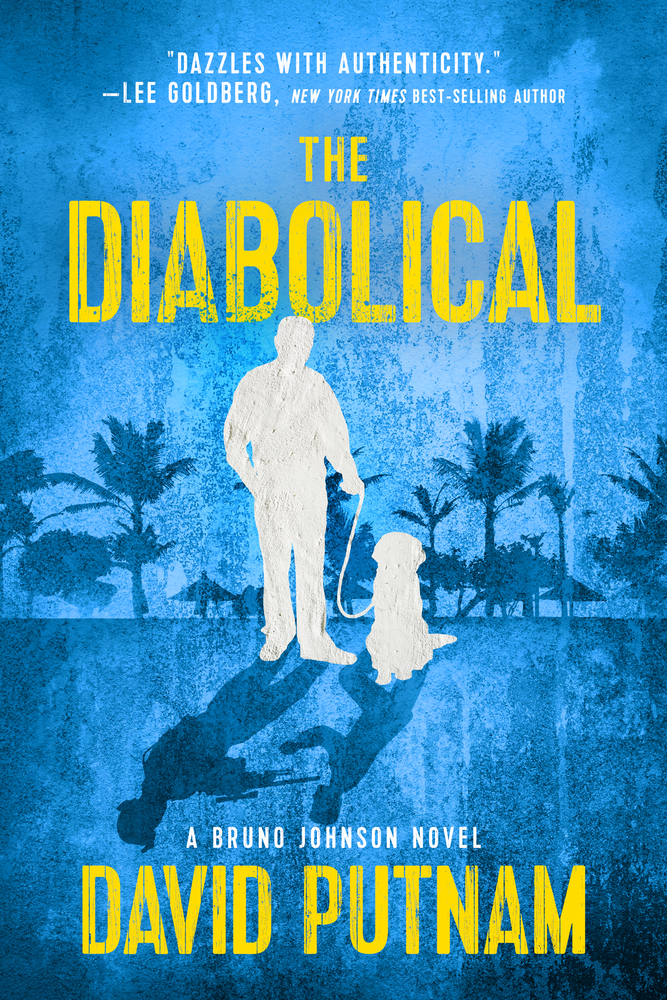
The Diabolical: Killings in Costa Rica

The Diabolical by David Putnam is #11 in the Bruno Johnson crime thriller series.  I'd like to thank the publisher for my review copy. It was an advance reader copy when I received it, but this book has since been published on February 6th.  I finished it today post-midnight.  

I haven't read any previous books in the series.  It is important to note that Bruno Johnson and his wife have rescued thirteen children from abusive parents, but Marie, his wife, has recently given birth to their own first child.  

 In the eyes of the law, they are serial kidnappers.  The proper legal way to have proceeded would have been to have gone through lengthy processes to get the children removed from their parents' custody.  Each removal would need to be litigated separately. Then, if those were successful, each child probably would have been put into foster care where they may have continued to be abused.  Bruno and his wife, Marie, are wanted in the U.S. and now live in Costa Rica which had no extradition agreement with the U.S. when they settled there, but now they do.  So their life in Costa Rica is very precarious.

Bruno has a private investigator's license which I imagine he would have lost if he were extradited due to the kidnapping charges.  In Costa Rica, he is a hotel bartender.  I am wondering how Bruno and Marie are taking care of thirteen children on a bartender's pay even if he receives generous tips.  That doesn't seem credible even if the cost of living is very low in Costa Rica.


So now we move on to the current case.  Six people were killed in a mass shooting at the local night club, El Gato Gordo.   Bruno thought that the shooter had come to kill one person, but was trying to confuse matters by shooting others. 

More corpses  turned up including one who had been buried up to his waist in the sand trap at the ninth hole in the hotel golf course. 

When a character survived having their throat cut, I looked up how likely that would be, and discovered that many people do survive such an event.  So I did learn something from this book that I would never have read on my own.  

 I expect to rate The Diabolical four stars on Goodreads.  It was very unpleasant, but Bruno was a rather sympathetic protagonist even though he was no saint.