Search This Blog

Tuesday, February 13, 2024

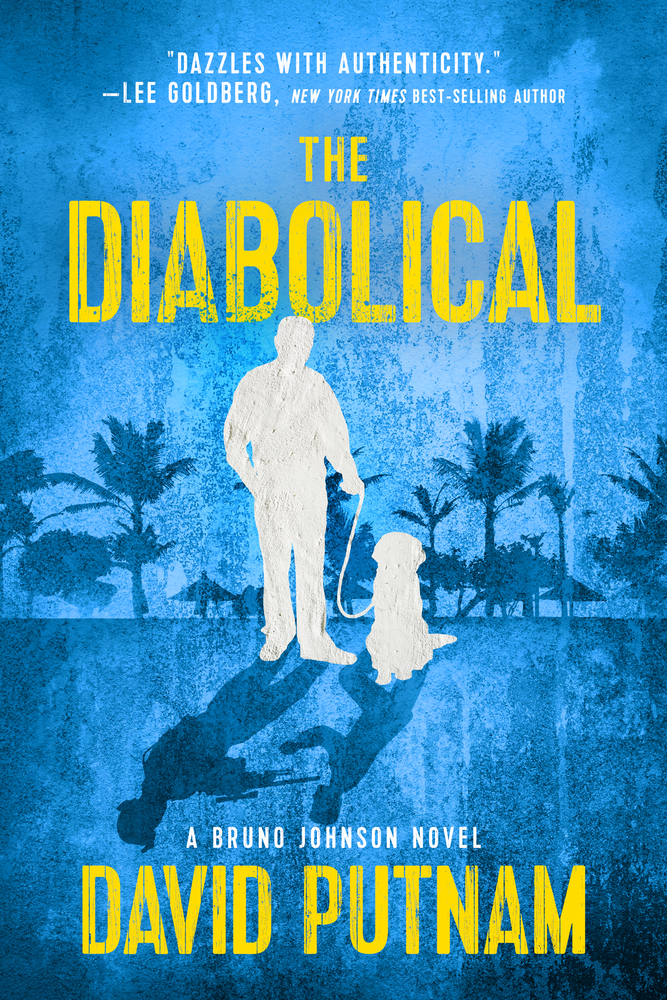
The Diabolical: Killings in Costa Rica

The Diabolical by David Putnam is #11 in the Bruno Johnson crime thriller series.  I'd like to thank the publisher for my review copy. It was an advance reader copy when I received it, but this book has since been published on February 6th.  I finished it today post-midnight.  

I haven't read any previous books in the series.  It is important to note that Bruno Johnson and his wife have rescued thirteen children from abusive parents, but Marie, his wife, has recently given birth to their own first child.  

 In the eyes of the law, they are serial kidnappers.  The proper legal way to have proceeded would have been to have gone through lengthy processes to get the children removed from their parents' custody.  Each removal would need to be litigated separately. Then, if those were successful, each child probably would have been put into foster care where they may have continued to be abused.  Bruno and his wife, Marie, are wanted in the U.S. and now live in Costa Rica which had no extradition agreement with the U.S. when they settled there, but now they do.  So their life in Costa Rica is very precarious.

Bruno has a private investigator's license which I imagine he would have lost if he were extradited due to the kidnapping charges.  In Costa Rica, he is a hotel bartender.  I am wondering how Bruno and Marie are taking care of thirteen children on a bartender's pay even if he receives generous tips.  That doesn't seem credible even if the cost of living is very low in Costa Rica.


So now we move on to the current case.  Six people were killed in a mass shooting at the local night club, El Gato Gordo.   Bruno thought that the shooter had come to kill one person, but was trying to confuse matters by shooting others. 

More corpses  turned up including one who had been buried up to his waist in the sand trap at the ninth hole in the hotel golf course. 

When a character survived having their throat cut, I looked up how likely that would be, and discovered that many people do survive such an event.  So I did learn something from this book that I would never have read on my own.  

 I expect to rate The Diabolical four stars on Goodreads.  It was very unpleasant, but Bruno was a rather sympathetic protagonist even though he was no saint.


Monday, January 29, 2024

Exsilium: The Founding of Roma Nova

I reviewed Nexus ,a previously published book in the Roma Nova alternate history series, back in 2019 on Flying High Reviews here. Exsilium is chronologically far earlier than Nexus since Exsilium deals with Roma Nova's founding in the late 4th century CE.

I received this book from the author, Alison Morton, earlier in the month. The title was spelled differently on the ARC I read.  I have corrected the spelling in this review.

 I decided to post my review of Exsilium to this blog because Roma Nova wasn't yet the matriarchal society that it later became.  Flying High Reviews is devoted to strong female protagonists, but it's also a more woman centered blog.  Shomeret: Masked Reviewer is my personal catch all blog that encompasses the rest of my admittedly eccentric reading history.


As the book opens the Fates have cut the life thread of someone who is fated to die at age 33.  This is tragically young in the modern era.  So it caught my attention. 

There are a great many characters in Exsilium.  We get to know those who are most central to the narrative.

Christians had become powerful in Rome. Those who continue to practice the ancient Roman traditions would be executed if they are discovered.  

I read a very interesting Wikipedia article dealing with persecution of Pagans once the Christians had become dominant in Rome.  You can find it here.  There is apparently a great deal of disagreement about how Paganism was eliminated in Rome.  Some  historians think there was a slow decline and others that it was hastened by persecution.

In Alison Morton's fictional version, the female protagonist of Exsilium and many of her associates left Rome in a hurry.  We learn the circumstances of those who decided to leave, and the plans they made for their future.  

Intolerance was an important commonality between what was happening then, and some current day problems.  I was sympathetic toward the difficulties of the protagonists who chose to exile themselves from Rome.

Roma Nova is a fictional community.  Yet I do wonder if there were any actual communities established by non-Christian exiles from Rome during this period in the established historical continuity.

I would give this book the very good grade of B+, and will award it four stars on Goodreads.


Sunday, December 31, 2023

My 2023 Retrospective


 Would you believe that I had almost twice as many views of this blog in 2023 as I had in 2022?  I'm astonished.  I read fewer books this year and posted fewer reviews.  Nice to know that so many more people wanted to see them.  I had a total of 64,387 views in this blog's entire history as of the end of  2022 and 79,622 total views at the end of 2023.

So in 2022 I had 8,346  views.   This year I had 15,235 views.  To me, that's a staggering statistic, but I'm glad to see it.  I must be doing something right.  

I read 37 books this year which is three fewer than last year. On the other hand, I had four five star reads, which is the same number as last year.  So I'm holding steady, but I hope I will have more five star reads in 2024.


Without further delay, I will now post those four books, which are the recipients of the Golden Mask Awards for 2023.

The Doctor and the Saint  by Arundhati Roy

This book caused me to re-evaluate Gandhi.  He apparently had typical prejudices against the Dalits who are the lowest caste in the Hindu religion.  This means that he shouldn't really be viewed as some sort of saint.

When We Do Harm  by Danielle Ofri

This book revealed how and why doctors make errors. We need to know that the practice of medicine is far from perfect despite the best intentions of medical doctors.  Doctors are human beings who are capable of making mistakes. 

Our Bodies, Their Battlefields  by Christina Lamb

This book dealt with rape in the context of war.  Lamb obtained the stories of wartime rape survivors.  I hope that Our Bodies, Their Battlefields will have an impact that will increase the prosecution of rape during wars.

The Violin Conspiracy by Brendan Slocumb

This year I had an A rated novel. So I would like to celebrate that fact. It's also the best mystery I read in 2023, but what most impressed me about it is the way the violinist author portrayed the relationship between the musician protagonist and his violin.  As I wrote in my review, "This novel lives and breathes music."  Bravo!


Monday, December 25, 2023

The Amish Wife: A Frightening Non-Fiction Book

 I received a hardcover copy The Amish Wife by Gregg Olsen in the mail. I'm not certain if it was directly from the publisher Thomas & Mercer or from the publicist Jennifer Musico, who has sent me quite a number of e-books.  I finished The Amish Wife on December 23.  I am writing this review on 12/24.  It was about a real life monster.


Apparently, the first book that Gregg Olsen wrote about killer Eli Stutzman,  Abandoned Prayers, isn't very different from The Amish Wife except for containing details about Stutzman's sex life. So readers who really don't want to know those details, would be better off reading The Amish Wife. I'm one of those who will probably never read Abandoned Prayers.

The Amish Wife states that the Amish believe that saying negative things about someone reflects poorly on the speaker.  Jews also believe this.  It's called Lashon Hara. (This is Hebrew for "evil tongue".)  This belief is probably why Amish were unwilling to say things they knew about Eli.  Olsen calls Eli "an Amish fabulist".  I understand "fabulist" to mean someone who tells stories that are either not completely true or absolutely false.  The stories with elements of truth are the most insidious because listeners need to determine when the fabulist is lying. 

Olsen tells us that the only way a marriage could be ended in the Amish community was death.  He believed that Eli killed his wife, Ida.  Eli was evidently gay and wanted out of his marriage.  So Olsen thinks the fabulist manufactured a story about her death that would allow him to evade responsibility for it. 

 Eli was the one who reported his wife's death to the authorities. His story about his wife being woken up by a fire in the barn and then wanting to milk the cows instead of rushing to get them out of the barn is a real doozy though.  I don't know how anyone could have believed that.  Ida's death was officially an accident.

Eli also made up stories about his son, Danny.  At the age of two, he allegedly wrote a note that he had fun on the beach.   I don't know of any brilliant two year olds who can write.  I learned to write at age six in first grade like most children. A two year old could theoretically learn to write, but there are prerequisites for writing.  I read online that children need to learn to draw to develop manual dexterity before they learn to write.  This makes sense to me.  Obviously, they also need to learn the alphabet.

At the age of nine Danny was found in a ditch frozen to death on Christmas Eve.  As I write this paragraph, it's still Christmas Eve 2023 and therefore the anniversary of that poor child's death. I wanted to cry when I read that.  He was supposedly a brilliant prodigy at two, but it looks like Eli couldn't be bothered with Danny seven years later.  I wish that Danny had been removed from Eli's custody before that happened.

I found Eli Stutzman's mug shot at a website called Daily Crime for those readers who are interested.  He looked like the sort of person who didn't care about anyone or anything.  He was sentenced to 40 years in prison in 1985, but was released in 2005. Stutzman committed suicide in 2007.  Good riddance!

 I can't say that I enjoyed this book,  but it was eye opening that this happened in the Amish community.  I suppose that the Amish are like everyone else.  They run the gamut of personalities.  Some Amish people try to behave decently toward their fellow human beings, and there may be a few who perform notable acts of benevolence, and then there are the people whose lives are horrors like Eli Stutzman.   I could never write one book about Stutzman, let alone two.  I wouldn't want to live with Stutzman's terrible actions for the length of time it would take to research and write about him.  This book was about terrible events.  It was well-researched and convincing, but I would be very happy not to encounter such a monster in the pages of a book in the foreseeable future.   True crime isn't a genre that appeals to me.  I hope my next read deals with people who don't make me feel sick.


Friday, December 1, 2023

The Secret Wife of Aaron Burr: A Petticoat Diplomat

 I considered whether this book could be considered my first strong female protagonist of 2023, so I could review it on my other blog that is devoted to strong female protagonists, Flying High Reviews.  I haven't reviewed any books there this year.  I decided that Mary Emmons didn't qualify even though the back cover blurb says she is a strong protagonist.  I think it's because she is a real historical individual. The complexity of a real person means that she won't have the stature that I want in a strong fictional protagonist.  That's the way I feel anyway.  We'll see if I can read any fiction with a strong female protagonist in December.  I hope so.

This is the second novel of Susan Holloway Scott, who is a bestselling author.  I read very few books by bestselling authors.  The last one I read was  Nothing Good Happens After Midnight: An Anthology Edited by Jeffrey Deaver in November 2020.  It will probably be some time before I read another book by a bestselling author.  

Petticoat Diplomat, the subtitle of this review, is a quote from Mrs. Prevost, who is a major character in the book.


There is a mention of Elizabeth Freeman who was the first African American slave to sue for and win her freedom in the state of Massachusetts during 1781.  In this book, a fictional version of Alexander Hamilton said this would never become a precedent in law because the Southern states wouldn't agree.  Yet it did become an important precedent in the state of Massachusetts.  In fact, it was one of the precedents that brought about the abolition of slavery in that state.  

Yet  The Secret Wife of Aaron Burr  largely took place in New Jersey, Pennsylvania and New York.  The Articles of Confederation governed the U.S. for almost that entire period.  The Constitution wasn't ratified until close to the end of this book. 

I liked this book enough to give it a B+ which means it will have four stars on Goodreads.  I have only one A rated novel so far in 2023 .  Since the year is almost over, I don't really expect that I will read another novel that I will consider that exceptional. We'll see. There is a slim hope that it will happen in December.


Monday, November 13, 2023

DNA and Evolution in The Violinist's Thumb

 I think that genetics does play an important role in people's lives.  Its role can be favorable or limiting.  Yet I also believe that when it seems as if your genetics are going to be a limitation, you shouldn't just accept that.  You should find out how to overcome those limits or compensate for them.   

The Violinist's Thumb by Sam Kean is a book dealing with DNA and evolution that I purchased from the sale cart in front of the local library's bookstore. I didn't read The Disappearing Spoon by this author though I am interested in it.  I decided to put it on hold at the library.  So I may be reviewing that earlier title in the forseeable future.


 I learned from this book that the famous pioneering geneticist Gregor Mendel (1822-1884) was embroiled in a disagreement with his fellow liberals who prevailed on the authorities to revoke the tax exempt status of monasteries in 1874 because of that disagreement.  At the time he was the abbot of an Augustinian monastery.  Augustinians are an order of monks whose founding document is The Rule of Saint Augustine  which was written circa 400 C.E.  Mendel fought for tax exemption but didn't  succeed.  This made him infamous and his papers were burned.  This must mean that we only know his work from secondhand sources because the originals don't exist.

Another important figure in the history of genetics, Hermann Muller, was considered a subversive who was placed under FBI surveillance.  When he established an institute in Germany, the Nazis vandalized it.  He joined the Communist side in the Spanish Civil War, but the Communists lost. 

I'm sensing a pattern here.  The best known geneticists have been dissidents.   I am reminded of the Scopes Trial that centered on the theory of evolution which is scientifically accepted, but remains controversial in some American communities.  I first found out about this trial by watching the movie about it, Inherit The Wind, as a teenager.

Kean discusses knots in physics which were first proposed by Lord Kelvin , a 19th century mathemetician, physicist and engineer.  Lewis Carroll, which was the pseudonym of Charles Dodgson , might have read Lord Kelvin's work at university.  Carroll published A Tangled Tale ,in which each chapter was called a knot, in 1880.  Knotted DNA wasn't discovered until 1976.

Getting back to the history of genetics, Nobel Prize winning geneticist Barbara McClintock, fought with her mother who wanted her do more feminine things rather than science and sports such as ice skating. 

 It's interesting that back in the 1920's ice skating was considered a masculine sport.  Now figure skating is often considered a feminine sport although there are certainly many male figure skaters.  Most of the fans of figure skating are women.

So a Russian biologist named Ilya Ivanov  was working on creating human/chimp hybrids that Kean calls humanzees.  The Ku Klux Klan sent Ivanov irate letters warning that he was doing satanic work.  He had to go as far as the Congo to find a physician who would work with him on using a chimp to impregnate human women.  When a governor in the Congo told Ivanov that he couldn't do his experiments in a Congolese hospital,  Ivanov went back to Russia to work in a Soviet primate station.  The Soviet police arrested Ivanov for "counter-revolutionary" activities and exiled him.  He was cleared of being a counter-revolutionary in 1932, but died of a brain hemorrhage soon afterward. 

 You know, I might have called a scientist who had such a tough time finding a place to do his work, a victim of persecution.  Yet I am actually delighted that ethics triumphed in this case. While I wouldn't call Ivanov satanic like the Ku Klux Klan, I definitely consider his work horrific and utterly repulsive.  The U.S. would not allow a patent to be taken out on humanzees on the grounds that the process of creating them would have violated the 13th amendment against slavery.  

 I had heard of The Year Without A Summer which happened as a result of a volcanic eruption in Indonesia in 1815.  That was the summer when Lord Byron got together with Percy Bysshe Shelley, Mary Shelley and Clare Claremont in Switzerland which resulted in the novel Frankenstein. See my review of Claire's Last Secret by Marty Ambrose, which deals more centrally with this event, here. That volcano eruption caused the sun to be dimmer for six years.

There is a reference in The Violinist's Thumb to the violinist and composer Niccolo Paganini having practiced on his violin while in prison.  I considered it dubious. I couldn't imagine a musician being allowed to keep a violin in a prison cell.

On the other hand, I found a website called  Music For The Future  which holds concerts and teaches courses in prison.  There is a video from that website which is dated two years ago in which professional musicians played music written by a formerly imprisoned composer. The musicians were wearing masks. So it's definitely a Covid pandemic era video.

There is a discussion of a genetic condition called Marfan's Syndrome in this book.  Lincoln may have had it, but his DNA was never tested because there was too much interest in commercial exploitation of it.  If Lincoln did have Marfan's Syndrome, he might not have lived much longer even if he hadn't been assassinated. 

The Violinist's Thumb has portions that were very enlightening.  So I do recommend it for people who are interested in genetics.


Wednesday, September 20, 2023

A Controversial Book Dealing With Revelations About Gandhi

This book actually deals with two figures.  It's called The Doctor and the Saint by  Arundhati Roy.  The "Saint" figure is Gandhi.  The other is Dr.  Bhimrao Ramji Ambedkar.  He will be referred to as Ambedkar for the remainder of this review.

 I got this book from the library, but it's the publisher that probably caused me to request it. I get e-mails from Haymarket Books.  Haymarket describes themselves on their website as a radical independent publisher.  Arundhati Roy surely does take a radical independent perspective on Gandhi.  I was overwhelmed by revelations.   This book caused me to totally re-evaluate him.                                    
                                  

The Doctor and the Saint  was originally written as an introduction to Ambedkar's book The Annihilation of Caste which was intended to be given as a speech.  The organization that invited Ambedkar to speak disinvited him after they read the advance copy.

My view of Hinduism had never focused on castes, but rather on the deities who are worshiped in Hindu temples.  I used to attend rituals at a Hindu  temple in the United States. I watched the priests bathe and dress the statues that were representations of the Gods.  I also heard the Hindu priests tell stories about the Gods before the rituals.  I thought that the Hinduism that I experienced was a wonderful religion.

Sometimes news happens that is relevant to the book that I'm writing about on this blog.  A  Canadian Sikh who was in favor of making part of India into an independent Sikh nation was murdered on 9/18 which is when I started this post. (Sikhism is a religion that began in the Punjab region of India in the 15th century. ) So this killing has impacted the relationship between Canada and India. Canada has stopped negotiating a trade deal with India.

In The Doctor and the Saint, it's stated that there is a belief that Hindus who convert to Sikhism are no longer part of the caste system.  It seems likely that the murdered Canadian Sikh who wanted to establish a Sikh nation on what is now the territory of India, was probably from India.  An independent Sikh nation where there are no castes would definitely be a magnet for Hindus of the "Untouchable" caste who would instantly want to become Sikhs.

The Doctor and the Saint did mainly focus on the impact of  Hinduism on the lowest status people known as "Untouchables".  The rampant prejudice, discrimination and violence against them would be regarded as offensive to all readers who believe in justice and human equality.  Gandhi's participation in Hindu attitudes  toward the Dalits who are called "Untouchables" for most of his life made him seem more like a fascist to me than a saint.  The author, Arundhati Roy, called Gandhi "the saint of the status quo".  Anyone who admires Gandhi, as I did before I read this book, should take The Doctor and the Saint's perspective on Gandhi into consideration.  This book deserves to be graded A.  I will give it five stars on Goodreads.