Search This Blog

Saturday, June 6, 2015

Gender Bias in Mystery and Romance Novel Publishing by Anna Faktorovich

I originally intended to review this book on Shomeret: Masked Reviewer, but I decided to post a brief version on Book Babe.  I have a bit more to say about this book here.

This is an academic study, but I thought I would try asking myself what a general reader would want to know about it.  I reviewed The Romances of George Sand by Anna Faktorovich on Book Babe.  I also interviewed her.  More recently, I received a free copy of Gender Bias in Mystery and Romance Novel Publishing from the author in return for an honest review. 
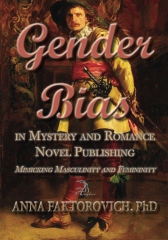
                                               
Gender Bias in Mystery and Romance Novel Publishing

                                           
First, I’d like to discuss what Faktorovich did right from the perspective of general non-academic readers.

1) She was honest about the fact that she usually didn’t read these genres, and didn’t portray herself as an authority about them.

 2) She selected both 19th century and 20th century writers in each genre so that long-term trends could be identified.

3) She showed that in the mysteries she studied, authors of both genders tended to be disturbingly sexist in their character portrayals.  Many of these mysteries have female victims who are undeveloped characters, and have no other prominent female characters. I read Faktorovich's results as showing that mysteries are more sexist than romances. Women in most of the romances she studied are active characters, and romance tends to portray the male and female protagonists as having equal social and professional status.

4) She was willing to consider the idea that erotic romances might be explorations of women’s sexuality and could have a feminist impact for authors and readers.

5) She included short biographies of authors that contained interesting facts about their lives which aren’t well known.

Now I’d like to enumerate some serious flaws in this book.

1)Faktorovich chose mysteries as the most male dominated genre.   Actually, the western is the genre with the largest proportion of male authors, but there are so extremely few female authors of westerns that you couldn't really do the sort of statistical study that Faktorovich wanted to do in that genre.  Yet science fiction is also more male dominated than mysteries, and does have a number of female authors who could be studied.  I think that it would have been more appropriate and more interesting to study science fiction instead of mysteries.

Faktorovich made a remark about science fiction being formulaic.  It is actually less formulaic than any other genre.  Those who have formed their opinion of science fiction based on movies would be astonished by the diversity of themes in 20th century science fiction books.  Since publishing in general has become more corporate, you can find a great many clones of bestsellers in 21st century science fiction, but that wasn't always the case. Science fiction began as a literature of ideas. Editors in the field used to reject books on the grounds that they weren't original enough.  This still happens to new authors submitting to science fiction specialty publishers.  Although "It's been done." is a phrase that can be applied to all types of authors, it's still a more frequent reason for rejection in science fiction than anywhere else.

2) Faktorovich had outdated notions of both the mystery and romance genres.  Both genres have developed in directions that weren’t addressed in this study.  Crossovers with other genres such as the romantic thriller or the paranormal romance that contains fantasy elements have become extremely popular in romance.    Publishers of mysteries now understand that women read more books than men, and are producing the sorts of books that they believe women want to read.

3)  She seemed completely unaware of mystery sub-genres.  The cozy and paranormal mystery sub-genres which are dominated by female authors would have been particularly relevant to this study.

4) She biased the sample of her survey by mainly distributing it on listservs for educators or librarians. It really isn't difficult to find listservs and discussion boards devoted to mysteries or romances.  Faktorovich could have included  more regular readers of these genres in her survey. 

 Faktorovich spoke of male authors gravitating to mysteries.  The best way to determine what authors want to write without the influence of the gatekeepers of traditional publishing imposing their ideas of what's marketable, is to take a look at the output of self-published authors.  Based on what I see on lists of self-published books, I would say that men gravitate to erotica and action/adventure thrillers.  Self-published mysteries by men are much less common.

I was astonished to see that an academic writer like Faktorovich displayed such  touching faith in the bestseller list as an arbiter of quality.   She said that if male writers were so poor at portraying characters and relationships, there wouldn't be so many male writers on bestseller lists.  I beg to differ.  I read so few bestsellers because I have found that most books that make it on to bestseller lists (by both male and female authors) contain stereotypical characters and relationships.   One example is the mega-bestseller, The Da Vinci Code by Dan Brown.  Apparently, the overwhelming majority of readers prefer books with little to no characterization.

Faktorovich said that more women don't write mysteries because women don't see themselves as detectives.   Many American women of my generation grew up reading a mystery series written for girls called Nancy Drew.  As a result, I told my parents when I was a child that I wanted to be a detective.  I remember being certain that I could be a better detective than Nancy Drew.  I eventually decided that I preferred the equivalent mystery series written for boys, the Hardy Boys, because I thought the protagonists were more intelligent than Nancy Drew.   I still don't identify with female protagonists unless they're intelligent. 

She wondered if women read romance because women write it.  Yet women do read m/m (the current term for gay romances) written by men.  Women also read m/m romances written by women.  I have to admit that I began to read m/m romances as a result of reading Mary Renault's m/m novels.

One part of Faktorovich's survey involved identifying the gender of the author of samples from novels.    A female survey participant said that women write feisty woman protagonists.  Actually, these days men write feisty female protagonists too.  They're popular.  In fact, the trend began with a male television writer by the name of Joss Whedon.  See my review of  a collection of essays about his television series called Reading Joss Whedon here.

I was completely flabbergasted that a passage by Henning Mankell was mistakenly identified as by a woman by a number of survey participants because they thought the characters were on a date.  Yet they were discussing a nuclear submarine.  Do people normally discuss nuclear submarines on dates? I can't imagine why anyone would have thought so.  I'm not familiar with the work of Henning Mankell, but it seemed self-evident to me that the passage in question was written by a man.  It dealt with a subject that is usually of concern to male writers.

The majority of survey participants mis-identified a passage by J. A. Jance as written by a man.  The protagonist/narrator is a man and this comes through very strongly in the passage. Jance is very successful in writing a male perspective.  I confess that I didn't know that J.A. Jance is a woman until fairly recently.   I would also have mis-identified the author's gender if I had read the passage from Jance's work that Faktorovich provided.  Yet Jance is scarcely the only woman who writes well from a male character's perspective.

Faktorovich thought she'd found a correlation between female mystery writers and divorce.  All the female mystery writers in her study were divorced.  I didn't encounter divorce in the online biographies of any of my favorite female mystery writers.  I'm pretty sure that this correlation won't hold true for the majority of female mystery writers.  Faktorovich believed that they would write romance if they weren't divorced because their income would be higher as romance writers.  She believes that romance publishers discriminate against divorced writers.

I know of two female mystery writers that began as romance writers for Harlequin.  One is recently deceased, but she and her husband were a very devoted couple who were collaborators.  They were bestselling authors in both romance and mystery.  Their names are Aimee and David Thurlo. The other is living and has had a long lasting marriage.  She is a bestselling author as a mystery writer, but was never a bestseller as a romance writer. Her mystery series has been adapted for television and is currently airing.  Her name is Tess Gerritsen.  I should also add that one of the romance authors in this study, mega-bestselling Nora Roberts, writes futuristic mysteries as J.D. Robb.  She is not divorced either.  So divorce wasn't the motivation  for these women's decision to write mysteries, and women can become bestselling authors in the mystery genre.

Although this is an interesting book, I think that Faktorovich missed a great deal in her exploration of gender in these genres. I also think that she didn't explore either of them deeply enough and that her ignorance of the genres led her to some false conclusions.


Tuesday, June 2, 2015

If The Oceans Were Ink: The American Woman Journalist and the Islamic Scholar

I originally posted this review to Book Babe, but  I wrote it for Shomeret: Masked Reviewer.  So I copied it to this blog.  

American journalist Carla Power has had an ongoing friendship with Mohammed Akram Nadwi, an Islamic scholar who teaches in the Islamic Studies program at Oxford University.  Power calls him Akram since Nadwi is the name of the school where he studied Islamic law.  She is a secularist whose parents also didn't practice the religions in which they had been brought up.   I wanted to find out about why Carla Power wanted to explore Islam when she wasn't religiously oriented.  


 After having read the memoir she’s written about her friendship with Akram and her study of the Koran with him, I think that Power wants to be reassured about Islam.  

Akram preaches against involvement in politics.  He also respects women.  He said to Power that women’s scholarship is purer than men’s because they aren’t paid for it.  Their only motivation is spiritual.   This is why he was motivated to write The Women Scholars of Islam which is a forty volume study.  Only the introduction has been published.  His publishers are seeking funding for the remaining thirty nine volumes.  I wanted to know more about these women, but only a few of them are even mentioned in this book which is disappointing. 

Power only writes intermittently about her discussion of the Koran with Akram.  I was intrigued as always by the Bible stories in the Koran.  Akram tells his students that you must be familiar with the Bible to read the Koran.  Actually, if you are familiar with the Bible and its historical context, you are likely to find the Koran’s versions of Biblical personages really strange. I consider this an experience in cognitive dissonance. 

Let me give one example.  Akram spoke at a mosque in England about what the Koran has to say about the Virgin Mary who is called Maryam in Islam.  He said that she was called to serve at the Jewish Temple.  He implies that she was a priestess of some sort.  From a woman’s spirituality perspective, this is a lovely story.  From a historical perspective, it couldn’t have happened.   It isn’t just a matter of women’s status in Biblical times, or the fact that Mary didn’t belong to a priestly family.  Jews had prophetesses, but no priestesses.  The reason is that priestesses are associated with Pagan religions.   Jews wanted to avoid any similarity to the practices of Pagans.  When you add in the element that Mary became pregnant out of wedlock, then you have a reminder of the Sacred Prostitutes of Astarte.  Islam has also tried to avoid any practices similar to the pre-Islamic religions of Arabia.  So they should understand why Jews might consider this idea that Mary was a priestess in the Jewish Temple rather offensive.   Akram said that the Koran wanted to honor Mary.  Perhaps the intention was to show that her virginity was protected in a sacred place, so it couldn’t be that Mary became pregnant as a result of sex.  Neither the Koran’s version nor the New Testament version of the story of Mary could be considered sex positive, but I would love to see a variorum edition which shows each Bible story and its Koran equivalent side by side. 

Power is also a friend of Akram’s family and devotes a great deal of space to his daughter Sumaiya.  As an indicator that Sumaiya made her own decisions, Power tells us that Sumaiya went against her father’s opposition to dying her hair.  She consulted another Muslim scholar who gave her a fatwa (which means an opinion on Islamic law) that hair dying is permissible, and she proceeded to dye her hair.  This also shows that Islamic scholars aren’t united in their interpretations.

There is a bibliography at the end of this book which includes the first volume of Akram’s study on Islamic woman scholars which I would like to read, as well as such books as Progressive Muslims: On Justice, Gender and Pluralism edited by Omid Safi and Inside The Gender Jihad by feminist Amina Wadud.  

 Unfortunately, If The Oceans Were Ink is not as interesting or insightful as I had hoped.  My feeling is that a secularist like Power, without any religious background, probably won’t ever have an in-depth understanding of Islam.


Sunday, May 24, 2015

The Translator: On The Unreliability of Perceptions

Translation is an interesting topic.  There are always terms in any given language that can only be approximated in a translation.  I have always wondered how translators handle such dilemmas and whether they believed themselves successful.  I mentioned a translator of the Koran who considered himself relatively unsuccessful in my review of Halal Monk here. 

The Translator by Nina Schuyler is a contemporary novel whose protagonist, Hanne Schubert, is a professional translator.  As the novel opens, she has just finished translating a Japanese novel into English and submitted it to the publisher.  An accidental fall causes her to lose the ability to speak any language except Japanese.  Japanese was a language she acquired as a teenager.  This is considered late for language acquisition.  People who experience memory loss generally don't lose the ability to speak their first language learned from their parents or other caregivers in early childhood, so this is a highly unusual circumstance.   Ignoring the advice of her doctor, Hanne Schubert decides that a trip to Japan would be the best way to deal with her problem. Although I rarely read contemporary literary fiction, this sounded like an original plot. I wanted to know how it would end.


I have to say that any cover that includes masks attracts my attention.  The Noh Drama masks and the cherry blossoms definitely evoked Japan for this reader.  I have often enjoyed novels that take place in Japan, though they are usually historical rather than contemporary.

Noh actor Moto comes into the narrative as the basis for the protagonist in the novel that Hanne Schubert had translated.  It occurred to me that a fictional version of a real individual is also a translation.  The author translates a living being into a character.   So Moto had gone through two levels of translation.   He was translated by Kobayashi, the author of the Japanese novel within Schuyler's novel, before Schubert's translation.   Then I realized that Moto as an actor is a translator as well.   The actor translates characters portrayed by authors into the medium of stage performance.

I was already aware that artists are translators.  I am fond of  Surrealist RenĂ© Magritte's famous painting of a pipe with the caption "Ceci n'est pas une pipe".  In English the phrase would be "This is not a pipe."  It's a two dimensional translation of a real pipe in oil paint on canvas.  Magritte selected a very safe subject.  A pipe isn't capable of complaining about the accuracy of the translation.

Translation goes wrong due to the subjectivity of the translator's perception.  Material involving two levels of translation is further away from the original.  The subjectivity of two individuals has intervened.  Each level of translation could vary according to the perception of each of those individuals.

I noticed my own subjectivity intervening in my interpretation of the book when a boy spoke to Hanne Schubert at an indoor artificial beach (a translation of the outdoor original).  He said "This is a pen."  In English, there is more than one definition of the word "pen".  It could be a writing implement or it could be a structure for the confinement of animals.  I thought the boy was expressing a sense of being confined by the artificial beach inside a building.   This felt like an important statement to me.  Then I read further and learned that "This is a pen," is one of the first sentences Japanese students are taught in English classes. The boy was trying to practice his English.  I had over-interpreted and given the boy's statement added significance that was unintended.  It was hard for me to let go of my interpretation even though it was essentially a translation error. 

On the macro level, the theme of The Translator is the limitations of perception.  All human perception is a translation of reality through the interpretation of our minds and senses.  No one ever perceives reality directly without it being translated.  Character relationships in this book are encumbered by differing perceptions of events and motivations.

 A huge misunderstanding separates Hanne Schubert from her daughter, Brigitte. Some may find it ironic that a translator who facilitates intercultural exchange of ideas can't communicate with her own child.  I felt that there was a tragic inevitability in their separation.  Their relationship was particularly vulnerable to mistranslation because of cultural differences.  Their backgrounds would necessarily cause mother and daughter to have completely variant understandings of their experiences.  This happens to all mothers and daughters to a certain extent since each generation is born into a world that diverges from the world of the previous generation. Yet when mother and daughter were born in different countries, their relationship becomes even more problematic.  Translation difficulties abound.  Only a conscious effort could bridge the gap between them. 

This is an intellectual review because the central concept of this book is a complex one.  It is matched by equally complex characters whose painful process of evolution is quite moving.  The Translator is a masterful novel that both engages and enlightens readers.


Saturday, May 16, 2015

A Dangerous Place: Jacqueline Winspear's Terrible Dilemma

I've just had the experience of reading through reviews of A Dangerous Place (Maisie Dobbs #11) on Goodreads after having read it myself.  I was looking forward to this book, though I admit I was at first disappointed when I discovered that it took place on Gibraltar rather than in India which is where Maisie had been headed after the end of the last Maisie Dobb's novel, Leaving Everything Most Loved.  A number of the reviews on Goodreads went far beyond disappointment.  This review is in part a response to them and a defense of Jacqueline Winspear's choices.  I am not associated with either Winspear or the publisher of this book, and I obtained my copy from a public library. 


It bothered me to see tirades  from readers about how they felt cheated of a HEA by this book as if this were a romance.  Reviewers even voiced the expectation that Maisie Dobbs could marry and continue her work as a private investigator.  These readers praise author Jacqueline Winspear's feel for the historical period,  yet they still had this extremely unrealistic expectation that would be totally false to Maisie's  context.

 My own response to the first few pages of this book was relief.  I was so glad that Winspear had found a way to continue the series.   I know that this sounds unfeeling when Maisie had gone through such tragic events, but I selfishly didn't want to be deprived of the future adventures of Maisie Dobbs. 

In Maisie's era, only lower class  Englishwomen worked outside the home after they married.  The main occupations of middle class and upper class women were running the household and having babies.  Aside from those, they could draw,paint, play a musical instrument, learn flower arranging or take dancing lessons.  They could also socialize,go to the theatre,visit museums and do limited charity work that didn't expose them too much to the realities of lower class life. These were a lady's socially approved activities.  For Maisie to continue investigating crimes would create a scandal.

 I'm sure that Maisie was aware that she couldn't continue with her work after she married.  This is almost certainly why she hesitated so long about marriage.   Yet she very much wanted to marry and have children.  It was a dilemma for any woman who had a career before marriage then, and it's a dilemma for any author who chooses to write about a woman's life before the second wave of feminism in the 1970's.

It's true that there are other historical mystery series that take place in the U.S. in which married women such as Rhys Bowen's Molly Murphy continue their investigative careers.   I ought to point out that since her marriage, Molly has had to deceive her husband, or invent excuses for her scandalous behavior.  Maisie's situation is also quite different from Molly's due to a difference in social class which has always been a much more important issue in England than it's ever been in American society.

As for the readers who wanted a Canada book, I have to repeat that this isn't a romance series.  It's a mystery/thriller series.  Given the circumstances, nothing could have happened in Maisie's life while she was in Canada that would have been of any interest to readers of mysteries and thrillers. 

I can understand but not sympathize with the readers who just wanted some more space devoted to Maisie's brief period in Canada in the form of flashbacks.  In  this case, Maisie has come to Gibraltar in order to avoid her memories.  People respond to grief in different ways.  Some people immerse themselves in memories because they consider them a comfort.  Others find memories too painful.  Because Maisie couldn't bear to remember her more recent past, she wouldn't have flashbacks to Canada in this book.  I've seen the argument that Maisie has never reacted to loss that way, but it seems to me that she behaves differently because of the impact of these particular losses.  I have also felt differently about losses that were particularly important to me.   I consider the portrayal of Maisie in A Dangerous Place psychologically authentic. 

Now let's get on to discussion of what was in the book rather than what wasn't there.  I hadn't fully realized what Gibraltar would have been like during this period.  I hadn't thought about the connection of Gibraltar to Spain.  I have read books and seen movies that took place in Spain during this period.  So I do have some familiarity with the Spanish Civil War.  I have seen the tapestry copy of Picasso's Guernica painting that was displayed at the United Nations building in New York until 2009.  None of this prepared me for the situation that Maisie encountered on Gibraltar.

 I hadn't understood the implications of German warplanes flying over Gibraltar.  Once I did learn why that was significant, I was as appalled as Maisie had been in the novel, and I completely empathized with the actions that Maisie felt compelled to undertake at the end of this book.  It demonstrated that Maisie is a "loose cannon" from the perspective of the British authorities.  This means that she is a woman who thinks for herself and acts on her beliefs.  I love that aspect of Maisie's character and very much liked the way this novel ended.


Saturday, May 9, 2015

Feeling For The Air: When Darker Elements Work In A Romance

Romance has requirements that cause it to be a rather formulaic genre which is why I read it so rarely.   Yet Feeling For The Air sounded very different.  Both the hero and the heroine aren't the sort of people that I'd expect to see in a romance novel.  I was curious and wanted to see how this totally non-formulaic story plays out.  There were also monarch butterflies.  How could I go wrong with romance plus butterflies?  That's why I purchased it from Amazon and reviewed it for the Bookplex.


  Feeling for the Air is the middle book in a trilogy about the relationship between bad boy Dace and his academic minded cousin, Liza.  So any HEA ending can only be provisional.  This is the first novel that I have read by Karen Black, but she introduced all the important background information that I needed to know from the first book in the trilogy in a very natural way.

 I do have to say that the cover didn’t really attract my interest. On the cover of the first book, From the Chrysalis, the monarch butterfly was the central image.  Since the search for the home of the monarch butterflies in Mexico was an important plot strand in this book, I wished that Black hadn’t already used that cover and that title for her first novel.  Emerging from the chrysalis also implies metamorphosis.  The two lovers begin to transform themselves in Feeling for the Air, but we only get a small symbolic butterfly on the cover.   I wish there could have been a monarch butterfly poised to take flight on this cover.  It would have echoed the title and the life stage of the two protagonists. 

I have nothing but praise for the writing. The sharp focus on the character viewpoints is magnetic, and the harsh realism of the characters’ dilemmas gave this novel impact.  From the beginning of the book, I threw my support to Liza.  I wanted her to finish school and make a good life for herself and her baby with or without Dace.   I could see that Dace was badly damaged and that all his instincts lead him toward trouble.  As I discovered more about his background, I understood what motivated his self-destructive pattern.  Yet I didn’t sympathize with him at all until he started to make a real effort to change his behavior at around the halfway point in the book.  I could see that his progress was shaky, however, and I wondered if he would ever become completely trustworthy.  Liza is also unsteady in her development as a mother.  She isn’t the ideal mother.  She doesn’t always put the interests of her child first and sometimes thinks about escaping her parental responsibilities. I did consider these truthful portrayals.  Major change in people’s lives takes place gradually.  They will hopefully mature as a result of their experiences. 
 
I was especially impressed with Liza’s choice of a midwife assisted home birth and the author’s choice of depicting the entire birth process.  Romance tends to shy away from the messier aspects of birth.  I consider this a bold choice because there are probably many readers who would consider it unromantic.  They would prefer a hazier approach to childbirth in which a mother enters a birthing room and emerges from it with a healthy child in the very next paragraph.  I very much appreciate Karen Black’s willingness to take on aspects of life that are usually airbrushed out of conventional romances. 


Sunday, May 3, 2015

Common Ground On Hostile Turf: When Resolving Conflict Isn't Enough

I discovered this book because I follow the science fiction author Cary Neeper on Goodreads.  She was really enthusiastic about the book.  I was motivated to read it because the protagonist of The Pipe Woman Chronicles, which I reviewed here, is a mediator.  Author Lynne Cantwell's portrayal of a mediator caused me to become interested in real life mediators.  I wanted to know about real life mediation cases and whether the results of mediations are honored by their participants.  So I obtained this book from the library to find out how mediation works.

                                                        16143903


Lucy Moore's stories about her mediation cases were fascinating to me.  Yet I wished that she was more committed to getting the best results for the environment rather than resolving conflict between  the parties in the mediation.  The compromises necessary to resolve conflict didn't always bring about any changes that would benefit the environment.  This would happen when a mediation prioritizes the concerns of government and industry, but marginalizes those of environmentalists.  Moore deals with the question of defining success in a mediation, but I don't think she gave enough thought to the topic due to her professional biases as a mediator.  I think that the perspective of the profession is short-term. If the main stakeholders have been included, she doesn't consider whether the failure to address the concerns of other stakeholders could reflect on the success of the mediation in resolving long-term conflict on the issue. 

Since she had lived on the Navajo reservation, Moore had credibility with Native Americans.  So she mediated in conflicts between the BIA (Bureau of Indian Affairs) and the governments of Native American nations that didn't have to do with the environment.

 Moore considered a mediation dealing with BIA schools a success. She didn't really consider the interests of Native American students. The purpose of the mediation was to implement No Child Left Behind (NCLB) in BIA schools.  NCLB is a failed educational policy that has caused all Americans to be left behind.   Our educational system has worsened as a result of this policy, and this is  negatively impacting the U.S. economy.   I am convinced that NCLB is one of the underlying causes of  our recession.  NCLB emphasizes the results of standardized tests which aren't an adequate measure of learning for all student populations.  Under NCLB, teachers have been  discouraged from employing creative approaches that will allow all students to succeed.  It's briefly mentioned in this book that Native Americans are one of the populations that aren't being well-served by standardized testing, but this issue wasn't brought up during the mediation.  A mediator who understood the educational issues involved would have assisted the Native American participants in preparing better.  They could have come armed with criticisms of  the effectiveness of standardized testing among Native Americans and gotten the government to address that concern.  No one at the mediation questioned whether NCLB would really be a desirable improvement for BIA schools. The mediation accomplished the goal of Moore's client, the BIA, but I considered it a terrible loss for the children it was meant to benefit.

Probably the worst example of conflict resolution without any benefit to the participants was when Moore's firm took on the running of the EPA's annual meeting at a Superfund cleanup site.  If I were her, you could not have paid me to take on that job. The EPA's purpose in hiring her was to make the meeting run smoothly for them.   They had no intention of actually doing anything for the residents.  These were people who had no potable water.  No government agency or NGO was even stepping in to search for a source of pure water for them.  Moore applauded an EPA official for recording the concerns expressed in the meeting, but the inadequacy of that response in the face of their emergency situation was staggering.

Reading this book showed me the limitations of mediation and conflict resolution in resolving many serious problems.  If a government entity is one of the parties in the mediation, the current political situation will be the most important factor in determining the results of the mediation.   This decreases my interest in mediation.


Wednesday, April 29, 2015

Islam in Saudi Arabia

Since reading and reviewing Halal Monk  I've been looking for more books that will help to fill in the blanks in my knowledge of Islam.  I've read so much about Wahabism, the dominant sect of Saudi Arabia, from the perspective of its opponents.   Yet I knew nothing about its history.  I also wanted to know about the beliefs of Wahabis  from a source that might be less biased than the sources I've previously encountered.  I don't imagine that there is such a thing as a completely unbiased source about any subject.  Islam in Saudi Arabia was published by Cornell University Press and was written by David Commins, a professor of history at Dickinson College.  He has done research on Wahabism in Saudi Arabia and has written a previous book on the subject called  The Wahhabi Mission and Saudi Arabia.  I downloaded Islam in Saudi Arabia from Net Galley and this is my honest review.
                                                     
                                                                                                                                                        
I think my most important takeaway from this book in the context of Saudi culture is that Wahabism is a longstanding ally of the Al Sauds who rule Saudi Arabia.  The 18th century founder of the tradition, Mohammed ibn Abd al-Wahab was very close to the Al Saud family of that generation.  As the power and status of the Al Saud family rose over the centuries, so did the religious influence of Wahabism.   The relationship between the Saudi monarchy and Wahabi clerics has been uneasy at times.  There has even been violent conflict over the role of religion.

 Wahabism sees itself as the most pure monotheistic sect of Islam.  Their criticism of other sects reminds me of  Protestant Reformation preachers condemning the saints of the Catholic Church.  Christianity has also had its controversies over monotheism. 

  Wahabi clerics usually concede the political realm to the government, and the  Saudi government usually allows Wahabi clerics to control all matters of religious life.  The Saudi situation isn't like the American idea of separation of church and state.  The Saudi monarchy does interfere with religion if religious leaders criticize them.   Since 9/11 there has been some liberalization of Saudi media.  Many issues are now openly discussed that had never previously been aired publicly.  The one thing that is still never allowed in Saudi newspapers, television or online forums is condemnation of  the Saudi government.

When I was reading the section in this book about women and sports in Saudi Arabia, I tried to think of sports that women could play veiled with the hijab prescribed by Wahabism called the  full niqab which covers a woman completely except for eye slits.  I thought that this hijab could interfere with vision. So  I did a search on veiled women playing sports.  I found pictures of veiled woman athletes, but none were wearing the full niqab of Wahabi women.  There was an article dealing with Muslim women wearing sports hijab at the 2012 Olympics.  The women shown were Shiites.   Unfortunately, sports hijab doesn't meet Wahabi standards.

Yet does hijab really block vision? I found an article that deals with this question as it affects driving.  Should Driving While Wearing Burqas Be Illegal?  The case involved an Afghani woman driving in France wearing the hijab prescribed by the Taliban which covers the eyes with a mesh screen.  Her lawyer argued this wouldn't impact vision.   The article advances the view that if this sort of hijab wasn't allowed for driving, then motorcycle helmets should be banned instead of mandated.   Yet I looked at the narrow slits of full niqab and thought that they weren't comparable. An Afghani woman in her hijab might really have a better view of the road than a Saudi woman in Wahabi hijab.  Does this mean that Saudi women really shouldn't drive?  I have a modest proposal.  Maybe the Wahabi  clerics should give permission for Saudi women  to wear the Afghan form of hijab while driving.

 I read  about a concern that soccer players wearing hijab in hot climates might be adversely affected in an article by Qanta Ahmed M.D. on Hijab in Sports  Yet it occurred to me that U.S. football players wearing helmets during hot weather would probably have the same problem.  I think that  a climate controlled dome would be a solution for both hijab wearing soccer players and helmet wearing U.S. football players in hot climates.   Another problem that Dr. Ahmed mentions involving the safety of hijab when a player is being tackled might be more intractable.   Perhaps hijab should not be worn for contact sports. 

I noticed that there is currently no digital edition of this book available for sale.  If Cornell University Press decides to make Islam in Saudi Arabia available in digital format, I would recommend that the endnotes be hyperlinked within the text.   As a reviewer who downloaded this digitally, I had a more difficult time checking sources than I would have had with the print version.  I couldn't simply turn to the correct page.  I have said this in a review before, and I think it cannot be said too many times.  Hyperlinking to endnotes should be standard practice for scholarly non-fiction in digital format.

This review is based on a publishing proof.  The final version may have revisions, but I would be remiss if I didn't mention any problems that I noticed during my reading of this proof.  I had some organizational issues.  It seemed to me that Commins couldn't decide whether he was going to present his subject chronologically or topically.  He tried to do both, and the result was a great deal of unnecessary repetition.   My preference would have been one consistent organizational approach.

 I learned a great deal from this book that I hadn't known about Wahabi history and practice.  I also learned about Shiites in Saudi Arabia, and how the political relationship between Saudi Arabia and Iran has influenced the status of  Saudi Arabian Shiites.  So I do think that this is a valuable book for Western readers.